Compound Bow Outdoor Competition: A Summary of 4 Types of Practical Experience and the Core Logic for Stable On-Site Performance

The complexity and pressure of outdoor competitions
Compound bow competitions differ from range practice. They test not only the archer’s technical skills but also their mental fortitude, adaptability, and strategic execution. The outdoor environment is complex and variable, including wind, lighting, temperature, and terrain changes, each directly impacting arrow trajectory, the archer’s stance, and the compound bow technique. More importantly, the time constraints, scoring pressure, and the presence of spectators or other competitors add psychological pressure. Top archers often demonstrate consistency in their performance, a testament to the highly integrated application of technique, psychology, and environmental adaptability.
Novice archers in outdoor compound bow competitions often overlook environmental variables or overestimate their skill level, leading to deviations in crucial shots. Understanding the complexity of outdoor competitions is the first step to improving consistency. Archers need to recognize that the competition is not just about compound bow archery, but also a systematic training in on-the-spot adaptability. Every shot is the result of multiple factors working together; neglecting any one of them can lead to a decrease in accuracy.
Practical experience 1: Accurate prediction of wind speed and direction
outdoor compound bow shooting, wind speed and direction are key factors affecting arrow trajectory. Even slight changes in wind direction can cause an arrow to deviate from its target by centimeters or even tens of centimeters. Top archers spend time observing the terrain before a competition, anticipating potential wind speed changes, and making fine adjustments based on arrow weight, arrowhead type, and sight settings. Through long-term training, archers develop the ability to quickly adjust their shooting posture and aiming point under varying wind speeds.
Beginners often underestimate the impact of wind, believing that experience from the shooting range is enough to hit the target. This mistake is especially fatal in outdoor compound bow competitions. In actual compound bow competitions, the arrow’s flight time in the air is short, but it is greatly affected by wind force. Ignoring even slight deviations in wind direction can directly lead to a deviated landing point. Top shooters train under simulated wind speed conditions, integrating wind speed adjustments into their shooting system to achieve greater stability in real-world shooting.
Practical experience 2: The impact of lighting changes on aiming and psychology
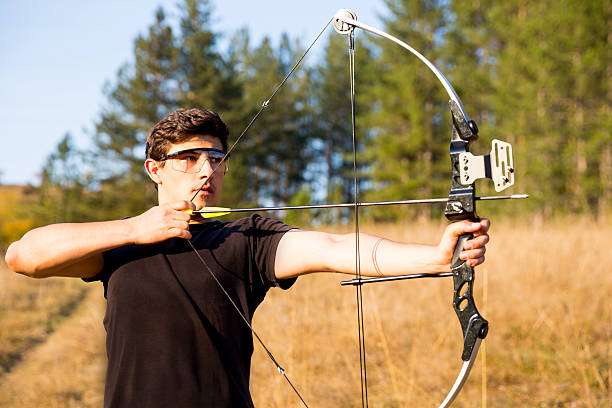
in outdoor compound bow shooting vary constantly with time and weather. Strong sunlight or shadows can affect the scope’s line of sight and the shooter’s visual contrast, making it easy for beginners to misjudge their aim. Top compound bow shooters observe the patterns of light changes before a competition, adjust the scope’s brightness or aiming point position, and train their eyes to adapt by simulating different lighting environments.
Changes in lighting not only affect visual judgment but also psychological state. Archers are prone to tension or stiffness in bright or low light conditions, causing arrows to deviate from their trajectory. By anticipating changes in lighting and adjusting their mindset, archers can maintain consistency in their movements and avoid shooting errors caused by lighting interference.
Practical experience 3: Adapting to changes in terrain and standing posture
Outdoor competition venues often feature undulating terrain, slopes, potholes, or soft soil. An unstable stance can directly affect the compound bow movement and the arrow’s trajectory. Top archers adjust their center of gravity, knee flexion, and footwork to suit different terrains, matching their movements to the ground conditions. Even in complex terrain, their movements remain fluid, and the arrow’s trajectory is stable.
Beginners often overlook the impact of terrain, using their usual stance for flat ground when facing slopes or potholes, resulting in stiff movements or uneven tension on the compound bow during shooting . Top shooters emphasize that every stance adjustment must be synchronized with breathing, core muscle activation, and aiming to ensure consistency in changing environments.
Practical experience 4: Psychological rhythm and on-site pressure management
In outdoor competitions, psychological pressure is a hidden factor affecting the stability of performance. Time constraints, competitors’ performance, and the audience all influence a shooter’s mental state. Top shooters transform tension and pressure into familiarity and rhythm through breathing control, mental rhythm training, and simulated combat. In every compound bow pull , aiming, and release maneuver, the shooter maintains synchronization between their mental and physical rhythm, ensuring stable shooting even under high pressure.
compound bow shooting often experience a drop in accuracy due to nervousness during crucial shots, leading to accelerated or stiff movements. Top shooters incorporate psychological pressure into their training system by simulating competition environments, setting up distractions, and practicing under timed conditions. This makes on-the-spot mental responses a natural part of the action, rather than an extra burden.
Technology integration and stability improvement strategy
In summary, four key practical experiences in outdoor compound bow competitions—wind speed and direction prediction, adaptation to changes in lighting, terrain-based stance adjustments, and mental rhythm management—constitute the core logic for consistent performance. Top shooters integrate these factors into their movement system through long-term training, making each shot a unity of technique, environmental adaptation, and mental control. If beginners can simulate these variables in training and develop a systematic approach, they will significantly improve their stability in outdoor competitions.
Technological integration extends beyond movement training to include equipment adjustments and arrow selection. Arrow weight, arrowhead type, fletching design, and sight adjustments must all be matched to environmental factors and the archer’s movements. Top archers conduct repeated trials to ensure a high degree of coordination between equipment and the technical system, minimizing the impact of environmental interference on the arrow’s trajectory.
Analysis of the core logic of on-the-spot performance
The core logic for consistent performance lies in the systematic management of multiple factors. First, there’s the standardization of technical movements, ensuring that the compound bow , aiming, and release actions remain consistent regardless of environmental changes. Second, there’s the anticipation of environmental variables, including wind speed, wind direction, lighting, and terrain; each factor requires a rapid adjustment mechanism. Third, there’s psychological rhythm management, transforming pressure into familiarity with the movements through breathing exercises, mindset adjustment, and simulated combat. Finally, there’s equipment matching, integrating arrows and sights with technical movements and environmental conditions to create a closed-loop shooting system.
The consistency displayed by top compound bow shooters in competitions is a result of this multi-dimensional integration. Every shot is a high degree of coordination between action, environment, and psychology. If beginners neglect any aspect, their performance may become unstable, leading to a drop in accuracy. Understanding the core logic allows for more targeted training, enabling shooters to maintain a high level of performance in complex outdoor compound bow competitions.
Summarize
Compound Bow outdoor competitions offer four key practical experiences: wind speed and direction prediction, adapting to changing lighting conditions, adjusting stance based on terrain, and managing mental rhythm. These provide archers with a systematic approach to ensuring consistent performance in real-world situations. By standardizing techniques, anticipating environmental changes, training mental rhythm, and integrating equipment, compound bow archers can maintain fluid movements and stable arrow trajectories in complex and ever-changing outdoor environments. Newcomers who systematically train in these skills and combine them with simulated competitions will significantly improve their results while avoiding unnecessary frustration and psychological pressure caused by mistakes on the day.
Consistent performance is not just a matter of technique, but also a comprehensive ability to manage the environment, equipment, and mindset. Understanding and practicing these four types of practical experience will be an important path for beginners to become high-level outdoor shooters, and also the core logic for achieving sustained success in outdoor competitions.
FAQ
Question 1: How to quickly predict wind speed in an outdoor
compound bow race? You can make fine adjustments by observing leaves, flags, and the surrounding environment, combined with the weight of the arrow and the characteristics of its tail feathers, to form a rapid response mechanism.
Question 2: How to maintain a stable stance in complex terrain?
Adjust your center of gravity, knee flexion, and footwork to match your movements to the ground conditions, while simultaneously engaging your core muscles to maintain balance.
Question 3: How does psychological tension affect the trajectory of an arrow?
Psychological tension can lead to stiff movements or releasing the arrow too quickly, causing it to deviate from the target. Through breathing control and mental rhythm training, tension can be transformed into familiarity with the movements, maintaining a stable trajectory.
Related Posts
8 ironclad safety rules for outdoor use of compound bows; one oversight could lead to lifelong regret.
-
Posted by
 Johnpaul Cremin
5 common mistakes in Compound Bow competition attire and equipment; wearing the wrong clothes can directly ruin your performance.
-
Posted by
Johnpaul Cremin
8 common fatal mistakes in Compound Bow matches: Why do beginners always collapse in crucial rounds?
-
Posted by
Johnpaul Cremin