5 key points for focus training with a compound bow: how to synchronize vision and breathing for accurate shooting.

focus in compound bow archery
Compound bow archery is a sport highly dependent on technique, strength, and mental fortitude, and the importance of focus is often underestimated by beginners. Consistent focus not only determines the fluidity of an archer’s movements in training and competition but also directly impacts accuracy. In actual shooting, archers must complete the chain of actions from drawing the compound bow , aiming, to releasing the arrow in an extremely short time; any distraction or mental fluctuation can lead to inaccurate shots.
One of the core reasons why top archers maintain accuracy under pressure in competition is their meticulous training in focus, achieving a high degree of synchronization between vision, breathing, and movement. Focus training is not merely about psychological regulation but a skill that completely integrates mental rhythm with physical action.
Modern archery psychology research shows that the stability of focus directly affects the accuracy of aiming and the fluidity of movements. If archers neglect focus training, even if their movements are proficient, they are prone to problems such as premature release, aiming drift, or muscle stiffness under pressure. The core goal of focus training is to shift attention away from external distractions and internal anxiety, focusing entirely on the target, breathing, and the chain of movements, so that each shot remains highly consistent and stable.
Key Point 1: Visual Focus and Goal Awareness
Visual focus is the first key to archery concentration training. Archers must learn to focus their visual attention on the target point of the arrow, rather than randomly scanning the surrounding environment. In visual focus training, archers not only need to accurately see the center of the target, but also maintain awareness of the target’s overall shape, lighting conditions, and distance. Top archers practice with their eyes closed or half-closed during training, first feeling the completeness of their movements, then opening their eyes to lock onto the target, achieving a high degree of synchronization between vision and action. Visual focus not only improves aiming accuracy but also reduces psychological fluctuations caused by environmental distractions, thus stabilizing hit rates.
Beginners often experience visual distraction, where their attention is pulled away by the background or external distractions during aiming, resulting in a disjointed action chain. Visual focus training requires compound bow shooters to turn their attention to the target while maintaining awareness of their own movements, thereby creating a unified rhythm in both mind and action, laying the foundation for high-precision shooting.
Key Point Two: Breathing Control and Movement Rhythm
Breathing control is the second key point in focus training and a core method for integrating mental state and movement rhythm. Archers use deep, rhythmic breathing exercises to adjust heart rate and muscle tension, bringing their bodies into optimal archery condition. During training, breathing and the compound bow pull must be highly synchronized; the rhythm of inhalation and exhalation directly affects arm stability and arrow release accuracy. Top archers strictly control their breathing rhythm with each compound bow pull and aim, releasing muscle tension through exhalation and maintaining core stability during inhalation.
Breathing control not only improves movement stability but also regulates mental state, reducing tension and anxiety. In high-pressure competitions, rapid or irregular breathing can easily lead to hand tremors and aiming errors. Through systematic breathing training, shooters can develop a synchronized rhythm between their mind and movements, resulting in natural and fluid actions, a close integration of vision and breathing, and improved accuracy.
Key Point 3: Psychological Rhythm and Focus
The third key to focus training is establishing mental rhythm. Archery is a sport requiring extremely high instantaneous precision, and mental rhythm determines the continuity and stability of movements. Compound bow archers, through mental suggestion, breathing control, and visual focus, tightly integrate mental rhythm with the movement chain, ensuring that each pull of the compound bow , aiming, and release maintains the same mental rhythm. Top compound bow archers emphasize that mental rhythm not only affects the stability of movements but also improves the ability to cope with pressure and distractions, resulting in more consistent and stable shooting performance.
Beginners often disrupt their mental rhythm under pressure, leading to disjointed movements or premature release. Mental rhythm training requires shooters to maintain synchronization between action and mindset in every shot, simulating the competition environment in advance through meditation or visualization techniques to form a stable mental pattern. This training method can reduce psychological fluctuations under high-pressure conditions and ensure the accuracy of visual and respiratory synchronization.
Key Point Four: Attention Allocation and Motor Awareness
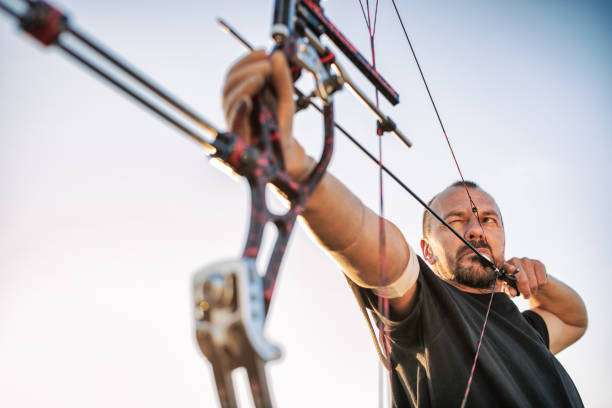
The fourth key point in focus training is attention allocation and motor awareness. Shooters need to allocate their attention between visual focus, breathing control, and mental rhythm, while maintaining awareness of the body’s movement chain. In training, shooters practice decomposition exercises, perceiving the muscle involvement and range of motion in each link, thereby achieving a high degree of integration between mind and action. Top compound bow shooters, in actual shooting, not only focus on the target but also remain sensitive to arm tension, shoulder stability, and core muscle status, synchronizing action with mind.
Beginners often focus excessively on a single aspect of the movement during training, such as aiming or breathing, while neglecting the overall coordination of the action. Attention allocation training requires compound bow shooters to simultaneously perceive the target, the action, and their mental state. Through systematic practice, this fosters a combination of automatic movement and mental focus, thereby improving accuracy and consistency.
Key Point Five: Synchronized Training of Vision and Breathing
Finally, the fifth key point in focus training is the synchronization of vision and breathing. This step highly integrates the first four key points, making visual focus and breathing rhythm part of the movement chain.
Compound bow shooters synchronize visual locking with breathing control through rhythmic breathing and target tracking exercises, making the actions of pulling the compound bow , aiming, and releasing natural and fluid. Top compound bow shooters in competitions can almost simultaneously control their breathing while visually locking onto the target, maintaining movement stability and mental focus, thus maintaining a high hit rate in crucial shots.
Visual-breath synchronization training requires compound bow shooters to establish a mental image before starting the movement, closely matching their breathing rhythm with their visual focus on the target. In actual training, this can be achieved through repeated practice in a simulated match environment, allowing vision, breathing, and movement to form a natural and unified rhythm. Long-term adherence to this training method not only improves the accuracy of compound bow shooters but also enhances their mental resilience and match adaptability.
Systematic application of focus training
By systematically applying five key elements—visual focus, breathing control, mental rhythm, attention allocation, and visual-breath synchronization—shooters can establish a stable psychological foundation and movement patterns in training and competition. Top shooters, through daily focus training, highly integrate mental rhythm with their movement chain, automating actions while maintaining a high level of concentration. Focus training not only improves shooting stability but also enhances mental resilience and adaptability in competition.
If beginners can systematically integrate these five key points into their training, they can not only significantly improve the accuracy and stability of their movements, but also reduce tension and distraction during matches, thereby increasing their overall shooting percentage. Focus training is a crucial bridge for shooters, enabling them to progress from technical skill to mental control, and from proficient movements to consistent performance in matches.
Summarize
compound bow archery focus training—visual concentration and target awareness, breathing control and movement rhythm, mental rhythm and focused state, attention allocation and movement awareness, and synchronized visual and breathing training—form the core path to improving archery stability. Through systematic training, compound bow archers can highly integrate their mental state, movement chain, and focus, achieving perfect synchronization between mind and action.
Top archers maintain a stable hit rate under high pressure precisely because of this mind-body integrated focus training method. If beginners can adhere to training in these five key elements, they will significantly improve movement stability, mental resilience, and focus, ensuring that every compound bow pull , aiming, and release is at its optimal state, thereby achieving consistently high-level performance in training and competition.
Focus training is not only a psychological adjustment method, but also a systematic skill. Through long-term practice, shooters can maintain calmness, focus, and fluid movements during matches, laying a solid foundation for stable accuracy and long-term improvement. Mastering five key points is the secret path for compound bow shooters to break through psychological limitations and improve stability and accuracy.
FAQ
Question 1: How long does it take to see results from focus training?
Usually, after three to four weeks of continuous daily systematic training, Sagittarians will see significant improvements in visual concentration, breathing control, and movement stability. Long-term adherence can form an automatic focus pattern.
Question 2: Is visual and breathing synchronization training suitable for beginners?
Yes, it is. Beginners can start with breathing regulation and visual target locking, and gradually add training in mental rhythm and attention allocation to achieve a comprehensive improvement in concentration.
Question 3: How to quickly apply focus techniques during a competition?
By practicing short breathing exercises, visual locking, and mental suggestion before the competition, you can synchronize your mind with your actions, quickly enter the optimal state of focus, reduce tension and distractions, and improve your accuracy.
Related Posts
Compound Bow’s top shooter’s 6-step pre-match preparation method: the ultimate secret to consistent accuracy.
-
Posted by
 Johnpaul Cremin

Compound Bow Archery Meditation: 4 Core Techniques and Hidden Paths to Improve Stability
-
Posted by
Johnpaul Cremin