8 common fatal mistakes in Compound Bow matches: Why do beginners always collapse in crucial rounds?

The Competition is Not an Enlarged Version of Training, But a Completely Different World.
A compound bow competition for the first time carries a dangerous and naive assumption: “If I can shoot like this in training, I’ll just be a little nervous in the competition.”
This assumption is precisely where a novice’s collapse in a compound bow game begins.
Competition is not an enlarged version of training; it is a completely different system with entirely different rules, rhythm, and psychological load. Training emphasizes whether technical movements are standard, while competition emphasizes whether you can maintain stable decision-making under the conditions of being observed, timed, compared, and judged.
The reason for collapse in compound bow is not because their “technique is not good enough,” but because they simply do not realize that the competition does not test archery skills themselves, but rather a person’s ability to manage attention, control rhythm, and assess risks under pressure.
When you treat a compound bow competition like “shooting arrows in a different spot,” your defeat is almost inevitable.
The First Fatal Mistake: Treating the Game as a Demonstration, Not as Execution.
The first mistake that beginners are most likely to make is that they have already gone astray at the psychological level.
In training, you only need to be responsible for yourself. If you shoot an arrow astray, you might feel a little annoyed at most. But in a competition, the presence of the audience, referees, fellow competitors, and the scoreboard will subtly change your motivation. You no longer just want to “shoot the arrow well,” but start thinking “don’t shoot too badly.”
This psychological shift may seem minor, but it can completely disrupt your shooting logic.compound bow
Once you start treating the game as a showcase, your focus shifts from execution to expected results. You’ll start thinking about what would happen if the arrow went astray before even lifting the compound bow, you’ll repeatedly check the bullseye while aiming instead of focusing on your own stability, and you’ll hesitate for a moment longer before releasing.
The compound bow is extremely sensitive to rhythm. Any additional psychological interference will be amplified at the moment of release. Novices often find themselves in situations where “I didn’t do anything wrong, but the arrow still flew away,” which is essentially due to the execution being mentally contaminated.
The competition isn’t a stage; it’s a cold, hard execution system. The sooner you realize this, the less likely you are to collapse.
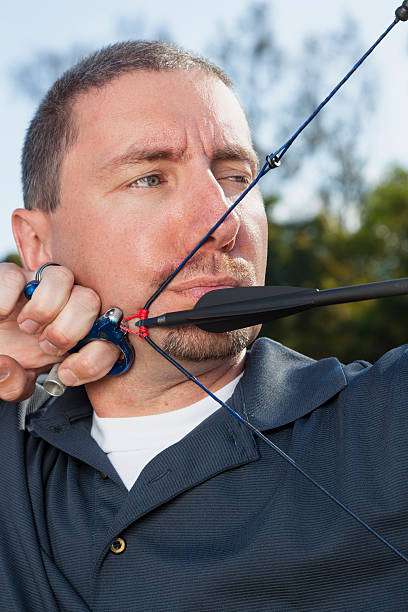
The Second Fatal Mistake: Losing Rhythm, Which is More Fatal Than Missing the Mark.
In training, you can shoot at your own pace, whether it’s faster or slower doesn’t matter. But in a competition, there’s a clear time window, and the time limit will directly change your perception of the movements.
Many beginners encounter two extreme rhythm problems during competitions:
- One is being pressured by time, shooting faster than usual, and rushing to release before the motion is fully established.
- The other is procrastination due to tension, repeatedly aiming and checking, leading to muscle fatigue and a loss of focus.
Both of these scenarios would destroy the core stability of the compound bow shot.
The compound bow is not a tool that improves accuracy with more aiming. Once aiming time exceeds your steady-state window, tiny muscle tremors and breathing variations accumulate rapidly. Beginners often mistakenly believe that giving themselves more time will improve their accuracy, but in reality, they are actively creating errors.
Truly skilled competitive shooters often strictly limit the execution time of each arrow. It’s not that they aren’t nervous, but rather that they know the most dangerous thing to do when nervous is to uncontrollably prolong the motion.
Once the rhythm is disrupted, all subsequent arrows will be affected. This is why beginners often miss several arrows in a row after missing one, rather than just missing occasionally.
The Third Fatal Mistake: “Last-Minute Technical Adjustments” During the Game.
This is one of the most fatal and common mistakes in novice compound bow games.
If the first few arrows don’t go well, beginners easily fall into a self-rescue mode. They start to doubt their stance, anchor point, aiming method, and even the adjustment of the compound bow. So, without any systematic verification, they begin to try fine-tuning their movements.
This behavior is dangerous even in training, and in a competition it is almost tantamount to self-destruction.
Any change in technique requires extensive repetition for the body to accept. Last-minute adjustments during a match often only throw your nervous system into disarray. You neither fully execute the original movement nor can you stabilize the new one, resulting in trial and error with every arrow.
A truly mature competition strategy involves determining your most consistent and least emotionally-affected moveset before the compound bow match. The only thing that can be adjusted during the match is your mental state, not your technical structure.
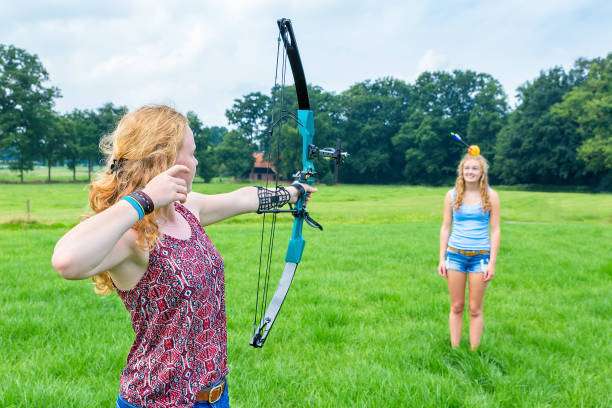
The reason for novice compound bow players’ failures is not that they shoot badly, but that they make the worst decisions after shooting badly.
The Fourth Fatal Mistake: Focusing Too Much on Other People’s Achievements.
There is a very tempting trap on the competition field: the scoreboard.
New players often subconsciously check their rankings, opponents’ scores, and skill gaps after each round. This behavior quickly shifts their focus from their own performance to uncontrollable external variables.
Once you start calculating the score difference, each of your arrows is no longer an independent unit of execution, but is given additional meaning. You’ll start thinking about how many rings you need to hit to tie the score, and you’ll become conservative when you’re leading and aggressive when you’re trailing.
Compound bow archery is making strategy adjustments based on emotions. You’re not playing cards or chess; there’s no room for “taking a risk” in archery.
Experienced shooters are often extremely indifferent to the scoreboard. They only care whether the current shot was completed according to the established procedure. The reason why novices collapse in crucial rounds is often not because their opponents are too strong, but because they care too much about their opponents.
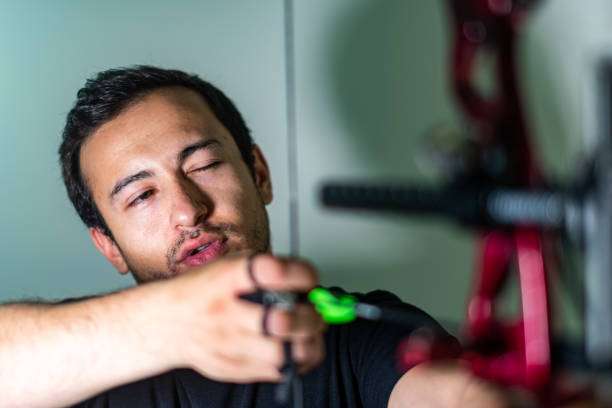
The Fifth Fatal Mistake: Misinterpreting Mistakes.
Mistakes themselves are not terrible; what is terrible is how you interpret them.
When a novice shoots a shot that clearly misses the mark during a match, they often immediately label themselves in their mind: “I’m not playing well today. I’m definitely not suited for matches. I’m going to collapse.”
This kind of self-narrative can quickly amplify the impact of a mistake. What was originally just a problem with a single arrow can quickly escalate into a psychological collapse of the entire match.
In fact, even top shooters sometimes miss their shots in a match. The difference is that they don’t attribute too much meaning to these mistakes. They simply see them as feedback, not a judgment of ability.
What beginners often lack is not technique, but immunity to mistakes. Once you treat mistakes as evidence that you are not good enough, your subsequent performance will almost certainly continue to decline.
The Sixth Fatal Mistake: Imbalance Between Physical Strength and Concentration.
Competitions often last a long time, which is a seriously underestimated challenge for beginners.
In training, you rarely maintain a high level of focus for extended periods. However, competition requires you to repeatedly enter a state of intense concentration for hours on end. This is extremely taxing on both the nervous system and physical strength.
Many beginners shoot very well in the first half of a compound bow match, but suddenly experience a significant decline in the second half. They often mistakenly believe this is a psychological problem, but it is actually more due to improper allocation of physical strength and concentration.
Compound bow shooting appears static, maintaining a stable posture, controlling breathing, and focusing for extended periods consumes a significant amount of energy. Beginners often overexert themselves in the early rounds, making it difficult to maintain the same level of control later on.
The competition is not a sprint, but an endurance race. Whoever understands this earlier is less likely to collapse in crucial moments.
The Seventh Fatal Mistake: Treating Referees and Rules as Interference.
Many beginners have only a superficial understanding of the rules of the game. They know the basic procedures, but they haven’t truly adapted to the psychological pressure brought by the presence of referees.
The referee’s gaze, commands, and note-taking can all make beginners uncomfortable. Some people unconsciously quicken their movements when the referee approaches, or become anxious while waiting for a ruling.
This maladjustment to the rules and environment will continuously deplete your psychological resources. The more you perceive the referee as a distraction, the harder it is for you to enter a stable state.
Mature shooters tend to view referees as part of the environment, rather than as an external source of pressure. They don’t change their behavioral rhythm just because they are being observed.
The Eighth Fatal Mistake: Overly Technical Pre-Match Preparation, Neglecting Mental Rehearsal.
In compound bow competition, beginners often focus all their energy on equipment, setup, and warm-up exercises, but hardly do any mental rehearsal.
They rarely think about how to cope if they don’t perform well in the first round, how to stabilize their emotions if they miss several shots in a row, or how to rebuild their routine if their rhythm is disrupted.
As a result, when they actually encounter these situations, they can only react on instinct, and instinct often goes out of control under high pressure.
The stability of a match depends on whether you have prepared strategies to deal with undesirable situations in advance. Novices without a mental plan will find it difficult to get back on track once they stray from their ideal path.
Why Do Beginners Always Collapse in Crucial Games?
In summary, the reason why novices collapse in compound bow competitions is not because they lack talent or skill, but because they have not yet completed the transition from a training mindset to a competition mindset.
Training focuses on how to get better; competition focuses on how not to be defeated by oneself.
Training allows for trial and error; competition has arbitrary punishments.
Training encourages exploration; competition demands restraint.
When you truly understand this, many of the so-called “fatal mistakes” of compound bow will actually disappear naturally.
FAQ
Question 1: Should beginners wait until their skills are fully developed before participating in competitions?
No. Competitions are a learning process in themselves. The key is not whether your skills are perfect, but whether you enter the competition environment with the right understanding.
Question 2: Is competition tension unavoidable?
Tension is unavoidable, but it can be managed. The real problem isn’t tension itself, but the poor decision-making it causes.
Question 3: If a team is already showing signs of collapse during a match, is there any way to salvage the situation?
Yes, but only if you stop trying to correct your technique and return to the most basic execution process. Any attempt to “fix the score” will likely only accelerate the collapse.
Related Posts
Compound Bow Outdoor Competition: A Summary of 4 Types of Practical Experience and the Core Logic for Stable On-Site Performance
-
Posted by
 Johnpaul Cremin
5 common mistakes in Compound Bow competition attire and equipment; wearing the wrong clothes can directly ruin your performance.
-
Posted by
Johnpaul Cremin