A comparison of the performance of 6 materials in Compound Bow : Why carbon fiber outperforms aluminum alloy.

In discussions about compound bows , tension, pulley systems, and aiming systems often take center stage, while the issue of materials is frequently simplified to “lighter is better.” However, shooters who have actually used various compound bows will find that materials are not simply a matter of weight difference, but rather a core factor that profoundly affects vibration feedback, stability, durability, and shooting consistency.
With the increasing popularity of carbon fiber materials in the compound bow field, a question has gradually emerged: why is carbon fiber gradually crushing traditional aluminum alloys in the high-end compound bow market? To answer this question, we cannot just look at the price or parameters, but must start from the combination of material physical properties and actual shooting experience.
the compound bow is not an isolated engineering choice, but rather an extension of the way people interact with equipment.
I. Why is the compound bow so sensitive to material properties?
The compound bow is a highly dynamic system. At the moment of release, the bow arm rebounds, the bowstring accelerates, the arrow departs, and the entire system undergoes a violent energy conversion in a very short time. The elasticity, density, and damping properties of any material are amplified into vibrations and feedback that the archer can perceive.
Unlike firearms that rely on mechanical structures for rigid locking and gunpowder gases to propel bullets, the compound bow has virtually no rigid locking mechanism. In the compound bow’s construction, the materials themselves become an integral part of the energy pathway. When the user draws the bowstring, force is transferred and stored through the materials. In this process, the materials withstand enormous stress and effectively transfer energy, ultimately transforming it into the propulsion for the arrow’s flight.
This unique characteristic means that the choice of material plays a crucial role in the user experience of a compound bow. It not only affects the bow’s appearance and durability over long-term use, but also directly determines the “feel” when shooting. This “feel” encompasses several aspects, including the smoothness of drawing the bow, the evenness of force feedback, and stability during shooting. Different materials vary in their physical properties such as elasticity, toughness, and density, and these differences directly impact the user’s experience of holding and operating the compound bow .
Because of the unique structure and energy transfer mechanism of the compound bow, the requirements for its materials are far more stringent than many who only consider its appearance or general use might imagine. The compound bow needs materials with high strength to withstand enormous tensile forces, good elasticity to efficiently store and release energy, and a certain degree of toughness to prevent breakage during repeated use. Furthermore, material stability is also crucial; it must maintain consistent performance under different environmental conditions to ensure accuracy and stability in firing.

II. Traditional Aluminum Alloys: The Industrial Foundation of a Stable Era
Aluminum alloy has long been the mainstream material for the main structure of compound bows , especially in the handle. Its advantages are very clear: stable strength, mature processing, and controllable cost, which has supported the industrial development of compound bows for a considerable period of time.
Aluminum alloy bow handles are typically manufactured using either integral cutting or forging processes. Integral cutting allows for precise machining of the aluminum alloy material according to design requirements, removing excess material to create a standard bow handle shape. Forging, on the other hand, applies immense pressure to the aluminum alloy, causing it to undergo plastic deformation at high temperatures to form the desired structure. Aluminum alloy bow handles crafted using these two processes possess high structural rigidity and dimensional accuracy. This excellent rigidity significantly benefits shooting by ensuring good geometric stability. During firing, the bow arm’s mounting angle remains constant, and the pulley axis is less prone to shifting, thus ensuring accuracy and consistency in shooting.
However, the inherent physical properties of aluminum alloys inevitably limit their capabilities. As a metallic material, aluminum alloy has a relatively high density. Under the same volume conditions, compared to some other materials, an aluminum alloy bow handle will be significantly heavier. This undoubtedly increases the burden on archers who need to hold the bow for extended periods. Furthermore, aluminum alloys have high vibration transmission efficiency. The moment the archer releases the bowstring, a high-frequency vibration is generated, and this vibration is more easily transmitted along the bow handle to the archer’s hand.
While this vibration may not necessarily have a substantial impact on the arrow’s trajectory and flight effect in many cases, it can significantly affect the archer’s experience. On the one hand, the high-frequency vibration transmitted to the archer’s hand reduces comfort, making the archer feel uncomfortable during shooting. On the other hand, this vibration can also affect the archer’s stability in continuous shooting, making it difficult for the archer to maintain a stable posture and exert force in subsequent shots, thus affecting the accuracy and effect of the shot.
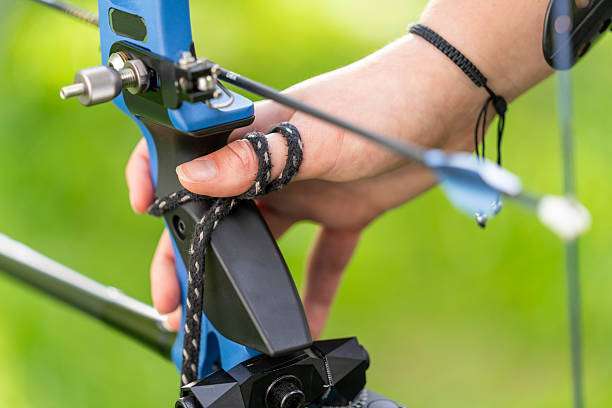
III. Carbon Fiber Composites: Born for Dynamic Systems
Carbon fiber is not a single material, but a composite system. It achieves high strength, low density, and designable elasticity through the combination of carbon fiber filaments and a resin matrix.
For compound bows , the most important advantage of carbon fiber is not just its lightness, but its “adjustability.” Engineers can adjust the fiber layup direction and density to make the material exhibit different stiffness and damping characteristics in different directions.
This anisotropy makes carbon fiber ideal for multiaxial load-bearing structures like compound bow . The bow handle must withstand tension while resisting torsion and vibration, and carbon fiber can be directionally reinforced to meet these requirements.
This is precisely where aluminum alloys fall short.
IV. The Real Impact Behind Weight Differences
On the specifications sheet, carbon fiber bow handles are often a few hundred grams lighter than aluminum alloy handles. The difference may seem small, but in actual shooting, this weight difference can be significantly amplified.
Compound bow shooting is not a single action, but a process of maintaining the posture for a long time. For every slight reduction in the weight of the bow handle, the load on the stabilizing muscle groups that the archer needs to engage during the aiming phase decreases. Especially in competition or long training sessions, this difference directly affects the consistency of movement.
More importantly, there’s the change in weight distribution. Carbon fiber bow handles can often concentrate the weight in a more balanced position while maintaining overall strength, making it easier to keep the bow vertical when naturally held.
This “natural sense of stability” is difficult to completely replicate by simply adding weight.

V. Vibration Control: The Invisibility Advantage of Carbon Fiber
compound bow for the first time is not its lightness, but its “quietness.” The vibration at the moment of release is significantly reduced, and the feedback to the hand is much smoother.
This is because carbon fiber composites have higher internal damping. Vibrational energy is absorbed and dispersed layer by layer within the material, rather than being conducted rapidly like in metals.
The significance of vibration control goes beyond just comfort. Lower vibration means less interference with components such as sights and arrow rests, and reduces the risk of minor displacements during long-term use.
Improved accuracy often comes not from a single “magical setting,” but from a reduction in system noise.
VI. Comparison of Temperature and Environmental Adaptability
Aluminum alloys are relatively sensitive to temperature changes. In cold environments, the metal will become noticeably cold, causing discomfort to the shooter when holding it, and the material’s elasticity will also undergo slight changes.
Carbon fiber has a much lower thermal conductivity than metals, resulting in a gentler feel. In extreme environments, carbon fiber bow handles respond more slowly to temperature changes, exhibiting greater structural stability.
compound bows outdoors for extended periods , this difference in environmental adaptation is not a detail, but a factor that directly affects the shooting experience.
VII. The distinction between durability and fatigue life
Aluminum alloys gradually accumulate metal fatigue under long-term repeated stress. Although it is difficult to reach the failure limit under normal use conditions, the accumulation of small deformations can still affect long-term accuracy.
Carbon fiber exhibits entirely different fatigue characteristics. Under proper design, it boasts an extremely long fatigue life and a much slower performance degradation. This is why high-end aerospace and racing applications extensively utilize carbon fiber structures.
for compound bows , which require maintaining geometric consistency over long periods.
VIII. Cost and Manufacturing Complexity
Carbon fiber is not without its flaws. Its manufacturing process is complex, and quality control requirements are extremely high, naturally resulting in high costs. This is the fundamental reason why carbon fiber compound bows have long been positioned in the high-end market.
In comparison, aluminum alloys remain a highly cost-effective choice, especially for the entry-level and mid-range markets, where their stability and reliability are still irreplaceable.
“Crushing” does not mean complete elimination, but rather a natural evolution under the demand for high performance.
9. Why did the high-end market choose carbon fiber?
When archers engage in archery, they consider various aspects of their weapon’s performance. Especially when archers demand higher standards from their weapon regarding weight, vibration feedback, stability, and consistency over long-term use, the unique advantages of carbon fiber materials become increasingly apparent. These advantages are not merely exaggerated descriptions at the parameter level, but rather a genuine experience that archers can directly perceive after thousands of actual shooting maneuvers.
For high-end compound bows, the design philosophy isn’t simply about pursuing the single performance metric of “greater power.” In fact, the core design concept of high-end compound bows is to provide archers with a user experience characterized by “less distraction,” allowing them to be more focused and stable during shooting. Carbon fiber material perfectly aligns with this design direction of high-end compound bows, effectively meeting their needs for reducing distractions.
10. Conclusion: Carbon fiber is not just about material, but about meeting the demands of the times.
Carbon fiber doesn’t beat aluminum alloys on every level, but it offers a superior solution in the modern compound bow’s pursuit of consistency in stability, comfort, and precision.
As shooters begin to pursue higher levels of control rather than simply brute force, the choice of materials naturally changes. The rise of carbon fiber is not a marketing gimmick, but an inevitable result of Compound Bow’s transformation from an industrial tool to a precision system.
What was truly “crushed” was never the aluminum alloy itself, but rather the boundaries of the old era’s understanding of performance.