Compound Bow : A Comparison Across 6 Eras – Ancient Archers vs. Modern Marksmen: Who is More Powerful?

Throughout the history of human weapon development, the bow and arrow has been present in almost every aspect of civilization. From a hunting tool in primitive societies to a core long-range weapon in the era of cold weapons, and then to a high-precision instrument in modern sports and hunting systems, the form of the bow and arrow has constantly changed, but the role of the “archer” has always been full of legendary charm.
With the advent of the compound bow , a long-standing question has resurfaced: if we compare ancient archers with modern compound bow archers under the same standards, who is truly more formidable? This question, seemingly simple, involves multiple variables from different eras, including technology, physical condition, training systems, battlefield environment, and even psychological structure. Simply answering it with “greater strength” or “more advanced equipment” is clearly insufficient.
To understand this difference, we must step outside the filter of film and television works and conduct a systematic comparison from six key historical dimensions to truly see the strengths of ancient archers and modern archers.
I. The Era of Survival and the Era of Competition: The Fundamental Shift in the Role of the Archer
In ancient times, the bow and arrow were tools that directly determined life and death. Whether hunting, fighting, or defending a city, archers faced irreversible consequences. Missing their prey meant starvation; missing their enemy meant being killed. This pressure to survive shaped the extremely pragmatic shooting mindset of ancient archers.
In contrast, modern compound bow shooters operate in a competitive and standardized environment. Even in hunting scenarios, there are clear legal restrictions, safety regulations, and room for error. Shooting is more of a combination of technical skill and psychological control than a simple survival game.
It is this fundamental difference in goals that determines that ancient archers tended to be more “results-oriented and powerful,” while modern archers tend to be more “accuracy and stability-oriented and powerful.”

II. Physical Structure Training: The Primal Strength Shaped by Long-Term Labor
In ancient times, the physical condition of archers was naturally formed through long-term, high-intensity labor. In the social environment of that time, the daily toil of farming, which required people to bend over for long periods of time to till the land, sow seeds, and harvest, was a great test of physical endurance and strength. Logging was also very arduous, requiring people to wield heavy axes, wrestle with hard trees, and repeatedly perform the action of chopping.
Carrying heavy objects was also common, moving supplies such as grain and timber from one place to another, which required strong muscle strength and a stable body. There was also military campaigning, with long marches on foot and various actions in battle, all of which placed extremely high demands on the body.
These daily activities resulted in ancient compound bow hands having higher bone density, tendon strength, and endurance levels than the average modern person. In particular, their shoulder and back muscles and core stability were often continuously strengthened starting in adolescence. During their youth, they may have already participated in various forms of labor and training, and as they grew older, the abilities of these body parts continued to accumulate and improve.
The high-draw traditional bows recorded in historical documents are not fictional creations of myths and legends, but are closely related to the physical adaptability of the people at that time. Ancient archers were not people who underwent short-term training; they were more like archers who “grew” out of the crucible of life itself. In their daily labor and life, they constantly trained their bodies, gradually adapting them to the demands of using high-draw traditional bows.
Modern compound bow archer training is highly scientific. Strength training is targeted, with detailed plans tailored to the archer’s physical condition and training goals. Movement breakdown is meticulous, breaking down the entire compound bow shooting motion into small, individual steps for analysis and training to ensure optimal performance for each movement. Gradually increasing draw weight allows the archer’s body to adapt, preventing over-fatigue and injury.
Fatigue management is also crucial, with training and rest periods carefully scheduled to maintain optimal physical condition. All training is conducted in a controlled environment, maximizing effectiveness and safety. While modern archers may not possess greater strength than their ancient counterparts, their body control precision and repeatability are significantly superior. They can maintain consistent movement and accurate shooting throughout repeated training sessions and competitions.
If we simply compare “who can draw a heavier bow,” ancient archers might have an advantage from the perspective of natural physical adaptation and long-term training. However, if we compare “maintaining consistency of movement under the same level of fatigue,” modern archers are clearly ahead because they have undergone scientific and systematic training and possess stronger body control and movement stability.
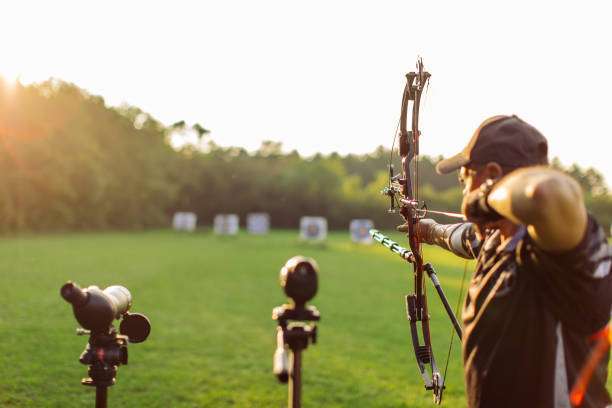
III. Differences in Weapon Technology: A Comparison of Empirical Countermeasures Engineering
In ancient times, the bow and arrow, this iconic weapon, relied primarily on extensive experience with materials and the craftsmanship passed down through generations. Take the bow itself, for example; the selection of wood was extremely meticulous, requiring precise judgment based on the characteristics, texture, and toughness of different woods. The ratio of horn to sinew was also not arbitrary; it required countless trials and adjustments to find the most suitable combination to ensure the bow possessed both good elasticity and strength.
The craftsmanship of the bowstring embodies the wisdom and experience gained through long-term practice of our ancestors, with each step being crucial. This knowledge and skill regarding the various components of the bow and arrow all stem from the accumulated experience of trial and error in practical operation.
Furthermore, this seemingly ancient and traditional weapon often possesses a strong individual compatibility with its user. Each meticulously crafted bow seems tailor-made for a specific user, allowing the user to develop a unique rapport with the bow over time, thereby unleashing the bow and arrow’s maximum power.
In stark contrast, the compound bow is a remarkable product of modern engineering. It incorporates numerous advanced design concepts and technological elements, such as a pulley system.
Through ingenious mechanical structure design, it can significantly alter the force distribution and trajectory of the bowstring, thus providing greater convenience and advantages for archery. The eccentric wheel structure is another highlight; the compound bow can flexibly adjust its tension according to different stages and needs of archery, making the shooting process smoother and more efficient.
The draw curve design is the result of precise calculations and optimizations, allowing shooters to significantly reduce physical exertion during the full draw phase while maintaining higher energy storage efficiency.
This advanced design concept greatly lowers the barrier to entry for shooting, making it relatively easy for even inexperienced beginners to use the compound bow. However, behind this seemingly simple and easy-to-use design lies a higher demand for detailed adjustments. Any slight misadjustment of parameters can affect the performance and shooting effect of the compound bow.
In general, the strength of ancient archers lay in their adaptation to the bow. They needed to spend a great deal of time and energy to familiarize themselves with and master the characteristics of the bow in their hands, constantly practicing and adjusting their posture, force application, and other aspects to adapt to the bow’s features and achieve optimal shooting performance. Modern archers, on the other hand, have the advantage of adapting the bow to themselves.
With the help of modern technology, the compound bow can be finely tuned according to the archer’s individual characteristics and needs, allowing the bow to better match the archer’s movements and force application habits, enabling the archer to complete shots more easily and accurately. It can be said that the powerful logic of ancient archers and modern archers is completely different; they represent the crystallization of technology and wisdom from different eras.

IV. Shooting Accuracy and Stability: The Difference Between Short-Term Lethality and Long-Term Consistency
In battlefield or hunting environments, ancient archers prioritized accuracy within the effective kill range, rather than high ring score precision in the modern sense. Targets were often moving and irregular, with short firing windows, emphasizing rapid judgment and immediate release.
Modern compound bow shooting is based on a highly stable cycle of motion. Shooters need to maintain minimal error fluctuations during the continuous firing of dozens or even hundreds of arrows. The requirements for “average performance” in competitive shooting are far higher than those for a single burst of fire.
If we compare “instantaneous decision-making ability and the ability to adapt to complex targets”, ancient archers are not inferior; but if we compare “long-term accuracy convergence ability”, modern archers have the advantage.
V. Differences in Psychological Structure: Pressure of Life and Death vs. Pressure of Rules
Ancient archers faced direct life-or-death threats. Fear, anger, exhaustion, and the instinct for survival coexisted while shooting. This extreme pressure made shooting a highly instinctive action, reducing the need for conscious thought.
Modern compound bow shooters face regulated psychological pressure. Competition rankings, performance expectations, and self-assessment all influence shooting performance. Although not involving life or death, this continuous and repeatable psychological load places higher demands on concentration and emotional control.
Both are psychologically strong, but their directions are different, yet both are equally real.
VI. Learning Path and Growth Cycle: Lifelong Archer and Stage Archer
For ancient archers, archery was not a skill for a specific period of time, but a lifelong ability. From childhood to adulthood, the use of archery was highly integrated into daily life, and the concept of “stopping training” was almost non-existent.
Modern compound bow shooters often take up the sport at a specific stage. Training time is divided into defined cycles and is significantly influenced by their lifestyle. This doesn’t mean modern shooters invest less effort, but rather that their investment is more focused and efficient.
The strength of ancient archers came from long-term accumulation; the strength of modern archers comes from high-density training and technical optimization.
VII. Who is stronger: The era’s trap in the question itself.
compound bow archers using a uniform standard, detached from their historical context . Strength is never a single indicator, but rather the result of the combined influence of environment, objectives, and technological systems.
Ancient archers excelled in their comprehensive ability to adapt to harsh realities, while modern marksmen excel in precise control and technical stability. The two are not substitutes for each other, but rather reflections of humanity’s different understandings of “shooting ability” at different stages.
VIII. The True Inheritance Relationship in the Compound Bow Era
The compound bow is not a denial of the spirit of traditional archers, but rather an inheritance and amplification of human shooting experience. The stability, focus, and consistency of movement pursued by modern archers essentially continue the ancient archers’ pursuit of efficiency and reliability.
Only when we stop obsessing over “who is stronger” and instead understand the underlying logic behind each powerhouse can we truly see the place of the compound bow in the annals of history.
IX. Conclusion: Strength has never disappeared, only its form has changed.
From ancient archers to modern compound bow shooters, humanity has never given up its pursuit of precision, power , and control. However, this pursuit has taken on different forms as times have changed . compound bow
True strength lies not in rally numbers or equipment technology, but in how people maximize their abilities in a specific era.