Compound Bow: 5 Practical Archery Techniques for Different Environments and Terrain Variations

Analysis of the complexity of the archery environment in the field
A compound bow in the field is far more complex than practicing at a firing range. Firing range conditions are relatively stable, with wind direction, lighting, and ground flatness almost entirely controllable. However, the field environment is full of unpredictable factors, including undulating terrain, vegetation obstruction, changes in wind speed and direction, and light and shadow interference. These factors not only affect the shooter’s visual judgment but also directly alter the arrow’s trajectory and release stability.
Beginners often underestimate the impact of terrain and environment on accuracy, believing that a correct compound bow technique guarantees a hit. However, in the wild, even minor changes in wind speed, an unstable archer’s stance, or deviations in arrow angle can be amplified, causing significant fluctuations in accuracy. Top archers conduct repeated simulations of different terrains during training to ensure high accuracy even in complex environments.
Terrain and environment not only affect technical movements but also psychological rhythm. Rugged terrain requires more attention to maintain balance, complex vegetation increases the difficulty of observation, and changes in wind direction can cause psychological tension. Environmental factors and psychological state interact to directly determine the final landing point of the arrow.
Tip 1: Adjusting the center of gravity and power when shooting uphill
Shooting uphill is one of the most common challenges in archery in the field. When an archer stands on an uphill slope, their center of gravity leans forward, making it easy to draw the compound bow too low. The way the shoulder and back muscles are engaged differs from shooting on flat ground. Beginners often overlook this shift in center of gravity, leading to errors in the compound bow angle and arrows landing either too high or too low.
Top archers, when shooting uphill, first adjust their stance, shifting their weight slightly forward to stabilize their body and keeping their knees slightly bent to absorb the impact of the slope on their balance. When drawing the compound bow, the shoulder blades and back muscles maintain a similar direction of tension to the horizontal ground, ensuring the arrow’s trajectory is close to standard.
In addition, the order of force application needs to be fine-tuned. When shooting uphill, shooters often instinctively use their lower limbs to maintain balance, neglecting the activation of their core muscles. Top shooters will activate their core first, and then smoothly pull the compound bow through their shoulders and back, making the movement continuous and stable. Through these adjustments, even on steep slopes, the arrow’s landing point can maintain a high degree of consistency.
Technique 2: Braking and Stabilization Strategies for Shooting Downhill
The challenge of shooting downhill lies in the shooter’s center of gravity shifting backward, causing the body to lean back and resulting in uneven pressure on the knees and ankles, leading to an unstable stance. Arrows tend to fly lower in downhill shooting, especially at long distances.
Top archers maintain stability by slightly engaging their core, bending their knees moderately, and using the balls of their feet. During the compound bow motion, the shoulder and back muscles must be kept high to prevent the arrow from sloping downwards due to a shift in the center of gravity. At the moment of release, the archer uses breath control and muscle coordination to ensure a smooth, uninterrupted movement.
Beginners often over-tension their arms in downhill situations, trying to compensate for a lack of balance with strength, which actually causes the arrow tip to tremble when released. Top shooters emphasize the coordination of center of gravity and muscle groups, maximizing consistency and accuracy by fine-tuning posture and the sequence of force application.
Tip 3: Observation and aiming in complex environments such as forests and vegetation
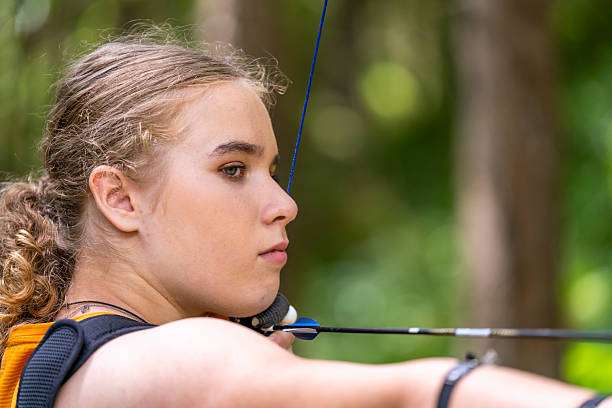
Archery in the wild often involves dense vegetation, where arrows can be obstructed by branches and leaves. Archers not only need precise aiming but also need to quickly assess the potential deviation of the arrow while observing the surroundings. Beginners often focus only on the center of the target, neglecting to clear the path and make visual judgments, causing the arrow to hit branches or miss the target altogether.
In such an environment, top archers will first assess the shooting path, determine the cleanest release window, and then adjust their stance and arrow angle. During aiming, they will consider the impact of changing light and shadow on their vision, especially in the interplay of light and shadow in the forest, maintaining a consistent visual reference between the arrow and the target.
Furthermore, controlling the release speed and angle of arrows is particularly important in complex vegetation environments. Arrows fired at too large an angle or with too fast a compound bow are easily blocked or bounced off branches and leaves. Top archers master fine-tuning techniques through simulation training to maintain a stable trajectory for the arrow in complex paths.
Tip 4: Corrections for changes in wind speed and direction
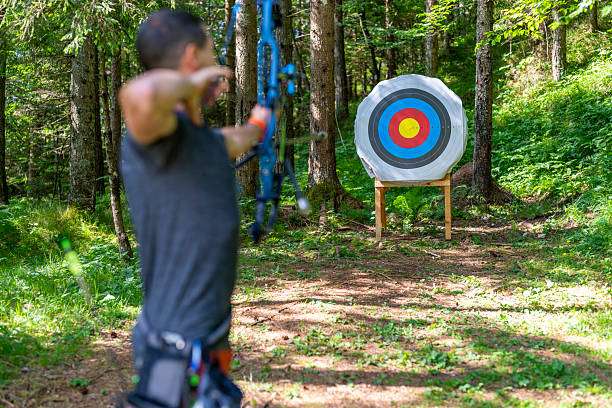
Wind direction and speed are the most difficult factors to control in field archery. Even a slight crosswind or a sudden gust of wind can change the arrow’s trajectory. Beginners often lack the ability to judge wind speed and make corrections, resulting in repeated misses. Top archers, through training, learn to fine-tune based on wind direction, speed, and distance to ensure the arrow’s landing point is close to the ideal trajectory.
Wind speed correction involves aiming point offset, adjusting the pressure of the compound bow, and controlling the arrow’s flight angle. In crosswinds, the archer will shift their aim laterally and fine-tune the draw and release rhythm according to the wind strength. Top archers will also use delayed release or slight adjustments to their breathing rhythm to stabilize the arrow’s trajectory on the target area when the wind speed is unstable.
Changes in wind direction can also affect mental state. Top compound bow shooters incorporate wind interference into their mental models through long-term training, maintaining consistent movements. Beginners often become tense or eager to correct their movements in the wind, leading to stiffness and a sharp drop in accuracy.
Tip 5: Adjusting your posture on uneven ground
In the field, the ground is often uneven and potholed, which restricts the stance of compound bow archers. The grip of the shoe sole, the angle of knee flexion, and the activation of the core muscles all affect the trajectory of the arrow. Compound bow beginners often try to use a flat-ground stance, which leads to a slight leaning of the body or excessive force on the knee joint, resulting in unstable movements.
Top shooters, when shooting on uneven ground, first assess their stance, finding a relatively stable support point, while fine-tuning the position of their knees and feet to minimize the impact of uneven ground on their center of gravity. In the compound bow motion, they use core stability and shoulder-back coordination to eliminate minor deviations caused by ground vibrations or unevenness, ensuring a smooth release.
In addition, shooters will moderate their firing pace on rough terrain, maintaining control rather than pursuing speed. A slow pace combined with precise balance is key to maintaining a consistent hit rate in complex terrain environments.
Outdoor archery training and psychological adaptation
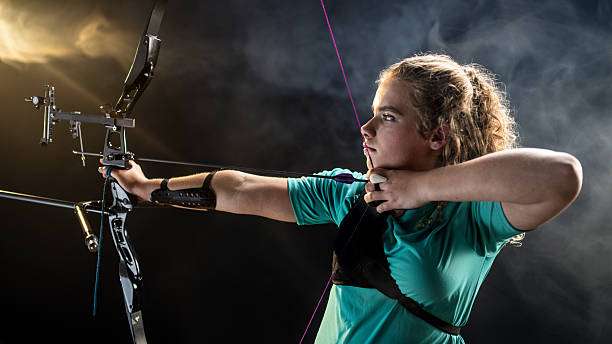
Archery in the wild is not only a technical challenge, but also a psychological one. The complex environment increases psychological pressure, causing archers to become stiff or anxious. Top archers incorporate various terrains, wind speeds, and lighting conditions into their training programs through outdoor training, thereby developing stable psychological and movement patterns.
Psychological training includes breathing control, visual focus, and mental rhythm management. Shooters transform psychological pressure into familiarity by repeatedly simulating shooting in different environments, maintaining consistency in their movements. Beginners lack this training and are prone to nervousness when facing real-world conditions, leading to deviations in their movements and a decrease in accuracy.
Meanwhile, field archery emphasizes the ability to quickly analyze and make decisions based on environmental information. Archers need to assess wind direction, lighting, ground conditions, and vegetation in real time, and adjust their stance, aiming point, and compound bow angle accordingly. Top archers incorporate environmental factors into their action decision-making system through training, while beginners often only focus on the compound bow technique itself, leading to large fluctuations in accuracy.
Summarize
Compound bow archery in the field differs from range practice; its complex environment demands higher precision in movements, a more stable mental state, and more strategic decision-making. From adjusting the center of gravity for uphill shooting to maintaining stability for downhill shooting, from choosing paths in complex forest environments to correcting for wind speed and direction, and even fine-tuning stance on uneven ground, every aspect can affect accuracy. Top archers incorporate these environmental factors into their shooting system through scientific methods and repeated training, achieving high accuracy and movement stability.
Beginners who rely solely on flat terrain training are prone to scattered movements, nervousness, and repeated mistakes in open field conditions. Understanding and mastering five practical techniques for different environments is the key to progressing from a novice to an advanced archer, and the ultimate secret to ensuring a consistent hit rate in open field archery.
FAQ
Question 1: How should the training frequency for compound bow drills in the wild be arranged?
It is recommended to schedule at least one outdoor training session per week, incorporating different terrains, wind speeds, and lighting conditions into the practice, so that the mind and technique can adapt to the complex environment simultaneously.
Question 2: How to maintain a consistent hit rate when wind speed changes drastically?
Top compound bow shooters stabilize their accuracy by observing wind direction, fine-tuning their aim and the force of pulling the compound bow, while also adjusting their breathing and movement rhythm, incorporating wind interference into their shooting decisions.
Is there a significant difference in posture when shooting compound bow uphill and downhill?
Very significant. When going uphill, the center of gravity leans forward, requiring fine-tuning of the core and shoulders; when going downhill, the center of gravity shifts backward, requiring coordinated control of the knees and core. Stance and the sequence of force application directly determine the arrow’s trajectory.