Compound Bow: 5 Environmental Differences in Combat: The Deadly Differences Between Forest and Mountain Shooting

Compound bow shooting is far more complex in different environments than most beginners imagine. In training ranges or indoors, shooters enjoy relatively stable lighting, wind speed, and ground conditions, making it easy to develop fixed action rhythms and aiming habits. However, when entering forests, mountains, or other complex terrains, the previously proficient technique is often disrupted by multiple factors, causing a sudden drop in accuracy. This difference is not accidental but rather a result of the combined effects of environmental physical conditions, psychological perception, and equipment adaptability.
the compound bow lies not only in its combination of strength and skill but also in its highly sensitive system, where every parameter is intimately connected to external conditions. Shooting in different environments tests not only the shooter’s operational skills but also their understanding and ability to adapt to those environments. This article will delve into the differences in the compound bow’s performance in actual combat from the perspective of five typical environments, helping shooters understand why the shooting experience in forests and mountains is fundamentally different.
I. Subtle Changes in Illumination and Visual Reference
In contrast, while mountainous environments offer more stable lighting, they are often accompanied by glare and high-contrast terrain. Reflected light from snow or rocks can interfere with aiming. Shooters must learn to choose optical reference points rather than blindly relying on the scope’s markings. Any habitual actions that ignore changes in lighting conditions will be amplified in both environments, directly leading to a decrease in accuracy.

II. The Hidden Challenges of Wind Speed and Air Density
In forests, trees and vegetation create localized wind speed variations. When a compound bow arrow traverses different wind currents, even slight deflections are amplified over time, especially at medium to long ranges, where such deviations can cause the arrowhead to miss the bullseye by tens of centimeters. Archers often struggle to visually determine the direction and intensity of the wind because visual references are obstructed by branches and foliage, making wind speed estimates unreliable.
In mountainous environments, winds are typically more stable but faster, especially at high altitudes. Reduced air density decreases drag on the arrow, potentially resulting in a slightly higher initial velocity but also a straighter trajectory. Even minor deviations in force can be amplified. In high-wind conditions, if an archer ignores the combined effects of air density and wind speed changes, the arrow’s trajectory can exhibit unpredictable tremors.
Wind speed affects not only the flight of arrows but also the archer’s stability. Unsteadiness and even slight body sway are magnified, which is why accuracy decreases even in calm mountain terrain.
III. Systemic Pressures of Terrain and Posture Adjustment
The challenges of mountainous environments lie in the slope and rocky terrain. Archers often need to stand on slopes or brace themselves on rocky edges, which places higher demands on lower limb strength and core stability. Even with perfect archer technique, slight slippage on the ground or asymmetrical support can affect the power transfer of the arrow at the moment of release, causing directional deviation. A commonality between forests and mountains is that ground conditions directly impact the archer’s physiological stability, and the high-precision system of the compound bow cannot compensate for this physical instability.
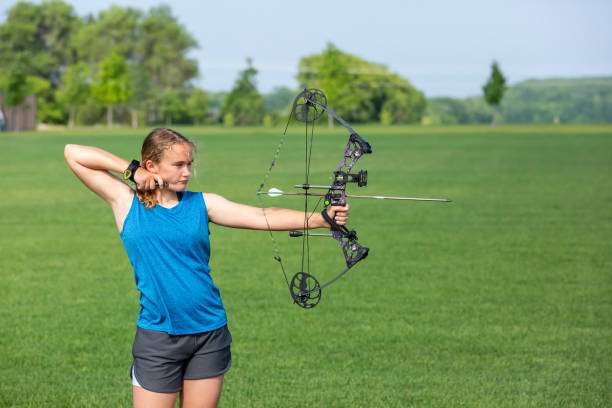
the compound bow and arrow due to ambient temperature
Compound bows are typically made of carbon fiber, aluminum alloy, or composite materials. Their mechanical properties are less affected by temperature, but the arrow’s elasticity, the compound bow string tension, and the coefficient of friction of auxiliary components will undergo slight adjustments with changes in ambient temperature. The damp and cold environment in forests will cause the compound bow string to contract slightly, and the arrow feathers may gain a slight weight after absorbing moisture. The low temperature and high winds in mountainous areas will reduce the compound bow arm’s recovery speed, causing a slight deviation in the force applied to the arrow at the moment of release.
These subtle differences are often overlooked by beginners, but in high-precision shooting, even a 1% difference in energy transfer can cause the arrow to deviate from the bullseye by several centimeters. This is why experienced archers make fine adjustments to the compound bow tension and arrow weight according to the environment, and it is also a technical aspect that is often underestimated in competitions and actual combat.
V. The combined effect of psychological and perceptual load
This psychological burden, combined with environmental physical factors, creates additional pressure on the shooter’s repetitive movements. In forests and mountains, a drop in accuracy is often not due to a single cause, but rather the result of the combined effects of physical and psychological factors. Understanding this complex effect is key for advanced shooters to maintain stability in actual combat.
VI. The Importance of Environmental Adaptation Training
The differences between forest and mountain shooting demonstrate that proficiency gained in a single training scenario cannot be directly transferred to complex terrain. Shooters need to practice systematically under varying lighting, wind speeds, terrain, and temperature conditions to build environmental adaptability. This involves not only repetitive training of shooting techniques but also adjustments to stance, breathing rhythm, aiming strategies, and mental rhythm control.
Excellent marksmen train using simulated environments. For example, they might simulate forest light and shadow and wind indoors using changes in lighting and fans, or practice compound bowing on slopes in mountainous terrain . This gradually allows their bodies and brains to develop conditioned reflexes to environmental changes. Through this training, marksmen can maintain stable movements and accuracy under complex conditions when they enter a real combat environment.
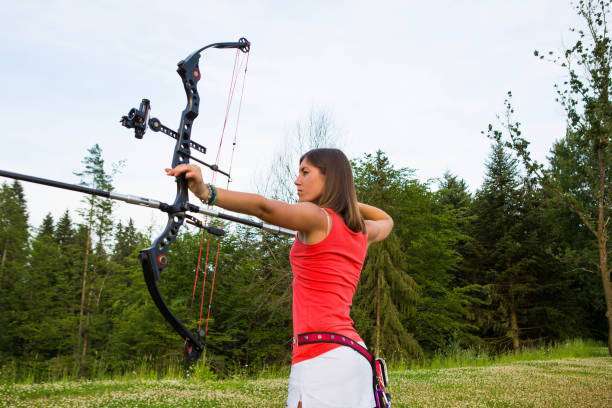
VII. Equipment Adjustment and Environmental Matching
Environmental changes also require archers to make targeted adjustments to their equipment. Arrow weight, arrowhead type, compound bow string tension, and auxiliary accessories all need to be fine-tuned according to the characteristics of forests or mountains. For example, in forest environments, slightly heavier arrows help penetrate branches and foliage, while in mountainous areas where winds are strong and the air is thin, slightly lighter arrows help maintain a straight trajectory. The sight graduations may need to be fine-tuned based on the observation distance and visual contrast, and the stabilizer length and center of gravity adjustments also need to take into account stance and terrain conditions.
These fine-tuning adjustments to equipment, working in synergy with the shooter’s technique, are essential to maintaining accuracy in changing environments. Ignoring the impact of the environment on equipment is a major reason why beginners frequently make mistakes in actual combat.
VIII. Conclusion: Environmental differences determine practical strategies
compound bow shooting relies on far more than just individual strength and technique. Different environments, such as forests and mountains, present different demands on lighting, wind speed, terrain, temperature, and psychological perception. The characteristics of each environment directly affect the arrow’s trajectory, the shooter’s stability, and their mental rhythm. Understanding these differences and engaging in systematic training and equipment matching is the only way to maintain a high hit rate in complex terrain.
Real-world shooting cannot replicate the ideal conditions of a training range. The advantage of excellent shooters lies precisely in their ability to maintain repeatable movements and psychological stability amidst environmental changes. The fatal difference between forest and mountain shooting is not a technical gap, but a comprehensive test of environmental awareness and coping skills. Mastering this ability is essential to unleashing the true power of the compound bow .