3 essential scientifically sound target training methods for compound bow beginners : the harsh truth that will save you 90% of the time and effort.

Many beginners to compound bow fall into a misconception in the first few weeks. The arrows fly, the target is hit a few times, and everything seems to be going smoothly. But the real problem is often not “whether you can hit the target,” but “why you hit it” and “whether you can replicate that next time.” This is the root cause of countless beginners’ subsequent stagnation, giving up, and even frustration with compound bow.
Compound bowing isn’t an exercise built on feeling; it’s essentially a complex system heavily reliant on repetition and neural adaptation. Every time you pull a compound bow, aim, and release, it leaves a trace in your body and brain. The problem is that most beginners, in the early stages of training, don’t leave behind the “correct trajectory,” but rather an “incorrect but temporarily effective compensatory path.”
The true significance of simulated target training is not about saving money, staying home, or casually practicing compound bows at home. Its core value lies in forcing shooters to focus on the action itself, rather than the result, when the actual hit result is stripped away. This is precisely where the vast majority of beginners get it wrong from the very beginning.
Why do most compound bow beginners go down the wrong path from day one?
In archery forums, video platforms, and clubs, the most common saying is, “Shoot more, practice more, and you’ll get the feel for it.” This statement might hold some truth for compound bow archery, but it’s extremely misleading.
The compound bow allows archers to occasionally achieve good results even before a stable structure is established. The pulley system, the breech, the release mechanism, and the sights together constitute a “delayed feedback mechanism.” The arrow you hit today may not be because your movement was correct, but because the equipment covered up your mistakes.
When beginners repeatedly shoot at real targets every day, their brains prioritize remembering the “feeling of hitting the target” rather than the “cause and effect of the action.” This leads to an extremely dangerous process. The shooter unconsciously adjusts the pull, shoulder position, head angle, and even the release rhythm, all in an attempt to recreate that hit.compound bow
In the short term, this approach may make performance appear to improve. However, from a neuroscience perspective, it actually reinforces a highly unstable and unreplicable behavioral pattern. Once the distance increases, the environment changes, or the performance fluctuates, this system will completely collapse.compound bow
Truly scientific training is conducted precisely in an environment where there is “no hit stimulus”.
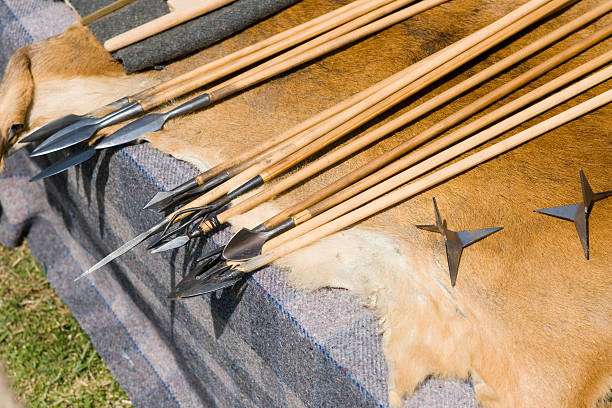
The essence of simulated target training is not “fake targets,” but rather training that de-emphasizes outcomes.
Many beginners, upon hearing “simulated target,” immediately think of foam targets, paper targets, or random shooting at close range. But this is only a superficial understanding. The core of true simulated target training is not the target itself, but rather “removing feedback from the results.”
When the target surface no longer provides a clear point of impact, the brain cannot determine success by whether it hits or not, and is forced to rely on the body’s internal sensory system. At this point, muscle tension, skeletal alignment, breathing rhythm, and visual stability become the only reliable sources of information.
This training method is initially very brutal. You’ll clearly feel that you have no idea which arrow in a compound bow is the “good arrow.” This uncertainty is precisely what beginners resist most. But in the long run, it’s the only way to build a stable archery technique.
The three scientific simulated target training methods discussed below target the three stages where beginners are most prone to problems: establishing structure, stabilizing neural rhythm, and eliminating psychological interference. They are not mutually exclusive, but rather represent a progressive training logic.
The first major scientific simulation target training method
Close-range, aimless structural training rebuilds the body’s “mechanical memory”.
This is the most basic and easily overlooked training method. The core goal of the compound bow is not to hit anything, but to teach the body to automatically return to the same biomechanical structure with each compound bow pull.
Training distances are typically controlled between one and two meters. The target can be blank foam, unmarked cardboard, or even just a safety backplate. The key is not what the target looks like, but whether you have completely given up the desire to “aim and hit.”
At this distance, it’s almost impossible for an arrow to deviate from a safe range, so the archer doesn’t need to correct the direction visually. The role of the sight is deliberately diminished at this stage, and it can even be temporarily obscured.
When you pull the compound bow into the valley position, your attention shouldn’t be on the target, but rather on the change in scapular position, the activation sequence of the back muscles, and the pressure distribution between your lead hand and the compound bow handle. Many beginners realize for the first time at this stage that what they previously called “stability” was actually a false stability achieved by forcing their forearms and wrists together.
Training without aiming points amplifies these issues rapidly. You’ll notice a slight collapse, shoulder shrug, or shift in your body at the moment the arrow leaves the bow. These details, often overlooked in long-range accuracy training, become exceptionally clear here.
Scientific research shows that when motor skills are repeated in a low-cognitive-load environment, the nervous system is more likely to form stable movement patterns. Close-range simulated target training utilizes this principle, stripping away all unnecessary information and leaving only the movement itself.
Beginners who persist in this stage of training often experience a noticeable change after a few weeks. Even when returning to normal target distance, the stability during the compound bow and the body’s balance after release will significantly improve. This is not because their strength has increased, but because their body has finally begun to “remember” the correct structure.

The second major scientific simulation target training method
Time-controlled release training to overcome the most fatal rhythm illusion for beginners.
If the first type of training addresses whether “your body is standing correctly,” then the second type of training addresses whether “you are being led by time.”
Almost all compound bow beginners unconsciously pursue a feeling of “shooting out quickly.” Once in a fully engaged state, heart rate rises, breathing becomes shallow, and the brain begins to urge release. This phenomenon is not due to poor mental fortitude, but rather an instinctive human reaction under tension.
The problem is that the precision of the compound bow is precisely based on the reverse control of this instinct.
The core of time-controlled release training is not about dictating that you must release the arrow within a few seconds, but rather about deliberately disrupting your original release rhythm. During training, after drawing the arrow to the anchor point, the archer needs to maintain a stable structure and hold the draw without releasing for a period significantly longer than their comfort zone.
This process is extremely grueling. The shoulders will start to protest, the lead hand will tremble slightly, and the aiming point will become uneasy, even on a simulated target. But it is precisely in this state that the shooter can truly distinguish between “structural stability” and “psychological stability.”
Many beginners are surprised to find when they first do this kind of training that what they thought was “aiming and completing” was actually just “not being able to resist.” Once the time is extended, all the releases that were done on impulse will be exposed.
From a neuroadaptation perspective, this training can significantly improve a shooter’s tolerance to delayed rewards. The brain gradually learns that the body remains safe even without immediate release. This directly reduces tension during competitions or long-range shooting.
More importantly, when you return to a normal shooting rhythm, release is no longer an act of escaping tension, but a natural result of the structure being completed. This difference is the most fundamental dividing line between a novice and a consistent shooter.
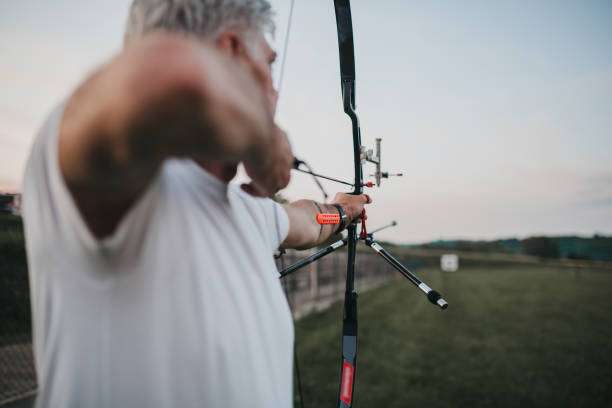
The third major scientific simulation target training method
Visual dissociation training allows you to stop being controlled by your brain.
Even with improvements in body structure and release rhythm, many beginners still experience self-doubt when their performance fluctuates. This is because they are still unconsciously led by visual results.
The third type of simulated target training is a brutal correction specifically targeting this psychological aspect.
Visual disengagement training is not about shooting archery with your eyes closed, but rather about deliberately reducing the dominance of vision in judgment within safe and controllable conditions. Common methods include using blurred lenses, obscuring the aiming point, or shifting attention completely from the target to bodily sensations during shooting.
When the point of impact is no longer clearly visible, the brain can no longer assess performance through visual labels of “good” and “bad” arrows, and can only focus on the execution of the movement. This kind of training can make archers feel extremely uneasy in the early stages because the familiar feedback system is cut off.
But it is precisely in this unease that archers begin to establish truly internal evaluation standards. Whether the shoulders are balanced, whether the release is clean, and whether the body maintains its posture after the arrow leaves the bow—these become the criteria for measuring the quality of an arrow.
Archers who have undergone long-term visual isolation training often exhibit a noticeable change after their vision returns to normal. They no longer rush to confirm the hit location, but instead focus more on preparing for the next move. This state is a typical psychological characteristic of high-level archery.
From a psychological perspective, this represents a shift from a results-oriented approach to a process-oriented one. And the sport of compound bow precisely rewards absolute control over the process.
The real, harsh truth about avoiding 90% of detours
If you’ve carefully read through the three training methods above, you might have already vaguely realized an uncomfortable truth. The problem is never that you don’t shoot enough, but that you start pursuing “hitting the target” too early.
Compound bow beginners isn’t upgrading equipment too quickly or not training enough, but rather spending a lot of energy reinforcing incorrect patterns. By the time they realize the problem, their bodies have already formed stubborn memories of those incorrect pathways, making corrections exponentially more costly.
Simulated target training is called “brutal” precisely because it deprives shooters of immediate satisfaction, forcing them to confront their own inconsistencies. This path is slow and the process is not glamorous, but it is the only one that can truly lead you to long-term stability.
When you can remain focused, stable, and confident even without the stimulus of hitting the target, the actual target score becomes a natural result rather than a goal to strive for.
FAQ
Why is simulated target training, which seems inefficient, considered scientific?
Because efficiency does not equal short-term hit rate. Simulated target training improves motor consistency and neural stability, indicators that are difficult to quantify in the short term but determine the upper limit of long-term performance. Hitting the target is merely a result, not the ability itself.
How should beginners allocate training time between real and simulated targets?
In the initial stages, simulated target training should occupy the majority, especially when establishing structure and release rhythm. Real target training is more for verification than for learning itself. As movement stability improves, the proportion of real targets can be gradually increased.
If you’ve already practiced on real targets for a while, will you regress when you return to simulated targets?
No. On the contrary, most shooters will identify and correct hidden problems more quickly after returning to simulated target training. Accuracy may fluctuate in the short term, but long-term stability will almost certainly improve.