Compound Bow’s 4 Core Technologies for Aiming: The Real Secret to Explosive Accuracy Increase

In the realm of compound bow shooting, many shooters experience a period of confusion. The draw weight is appropriate, the stance has been refined repeatedly, and the arrow matching seems reasonable, yet the accuracy remains stuck at a bottleneck. At this point, the problem often lies not in the “force,” but in the way the “seeing” is done. The compound bow sight is one of the key components that determines the upper limit of shooting accuracy.
In movies and television shows, archery is often portrayed as an almost intuitive act, as if hitting the target is as simple as aiming. However, in the real world, the improved accuracy of compound bows is almost entirely based on precision aiming systems. True masters are not those who “see more accurately,” but those who, through the use of aiming devices, transform the unstable human body into predictable and repeatable mechanical logic.
To understand why the accuracy of the Compound Bow has “skyrocketed,” one must delve into the four core technologies behind the sight. These technologies are not mysterious, yet they are often overlooked or even misunderstood by beginners.
I. Optical Reference Point Stability: Accuracy Doesn’t Come from “Seeing Clearly”
Many shooters, when first encountering a compound bow sight, subconsciously believe that the core value of the sight lies in “seeing the target more clearly.” However, in reality, the modern compound bow sight is not responsible for magnifying the target, but rather for providing a highly stable and repeatable optical reference point.
This reference point usually exists in the form of a aiming pin or fiber optic dot. Its purpose is not to help the shooter find the target, but to help the shooter determine whether their posture is consistent. As long as the same posture, the same draw distance, and the same anchor point are reproduced, the reference point will naturally fall in the same position.
The secret to improved accuracy lies not in how clear the target is, but in whether the reference point is stable enough. If the aiming pin shakes violently in the field of view, it means the shooter’s body control is not yet mature; as the amplitude of the shaking gradually decreases, accuracy will naturally improve.
The “rock-solid” aiming scenes commonly seen in movies and TV shows are almost nonexistent in reality. True professional shooting involves releasing the weapon within an acceptable range of sway, rather than waiting for a moment of complete stillness.

II. Multi-point aiming system: An engineered solution for varying distances
compound bow archery is the variation in distance. Arrows do not fly in a straight line, but rather follow a parabolic trajectory due to gravity. Ancient archers corrected their aim through experience, while modern compound bows have completely engineered this correction process through multi-point aiming systems.
Multi-point sights are not designed to make shooters “think more,” but rather to reduce subjective judgment. Different sight heights correspond to different shooting distances. Once the distance is determined, the shooter only needs to use the corresponding reference point to perform height compensation.
The dramatic increase in accuracy stems from a fundamental shift in this highly compensated method. It no longer relies on the shooter’s intuition but on precisely set parameters. Shooters no longer need to mentally calculate complex parabolic trajectories or adjust the pull output based on the situation. They simply need to rigorously replicate pre-determined actions and follow standard procedures to complete the firing process.
It’s important to note here that multi-point aiming systems do not automatically improve a shooter’s overall skill level. The compound bow merely amplifies the consistency of the shooter’s movements. In other words, if a shooter’s basic movements are not stable enough, or if there are many irregularities or uncertainties in their operation, the multi-point system will not only fail to help but will also expose more errors, making previously less noticeable problems more prominent.
III. Fine-tuning mechanism precision: How millimeter-level deviations are amplified into target misses.
compound bow shooting, there is a harsh but real fact: seemingly insignificant adjustments on the bow are magnified many times over at the end of the arrow’s flight. The fine-tuning mechanism of the sight is the key component used to control this magnification effect.
modern compound bow sights has reached the millimeter or even smaller scale. This precision is not for show, but to match the subtle changes in human movement. As the shooter experiences varying degrees of fatigue, the draw distance and anchor point will fluctuate slightly; the fine-tuning mechanism helps the shooter correct for impact deviations without disrupting their overall posture.
Without high-precision fine-tuning, shooters often have to compensate for errors by changing their stance or aiming habits. This method of compensation is extremely unstable and will disrupt the action structure in the long run.
A truly skilled marksman will view the compound bow sight as an “error management system” rather than a simple aiming tool.
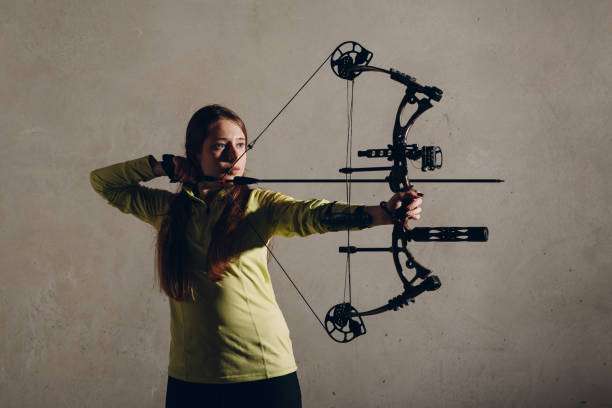
IV. Structural Rigidity and Seismic Design: Factors for Severely Underestimated Stability
Many people underestimate the importance of the rigidity of the sight structure, believing that as long as it can be aligned, it’s fine. However, at the moment the compound bow is released, the compound bow body will vibrate significantly. If there is even a slight deformation in the sight structure, this vibration will translate into a displacement of the aiming point.
When designing high-quality sights, designers pay particular attention to several key aspects, including material strength, connection structure, and shock resistance. Material strength is crucial for sights, directly affecting their ability to maintain compound bow stability over long-term use. The rationality of the connection structure influences the tightness of the fit between the various components, ensuring no loosening occurs during use. Shock resistance is equally important, ensuring the sight remains accurate even when subjected to vibrations or other external forces.
Sights that lack rigidity may appear to function perfectly and meet basic aiming needs in the short term after they are first put into use. However, as they are used more frequently, some potential problems will gradually emerge.
Due to insufficient rigidity, minute displacements occur with each use, and these displacements accumulate slowly. Over time, this cumulative effect becomes increasingly pronounced, eventually causing the sight’s hit point to become unpredictable and severely impacting shooting accuracy.
When we see a shooter’s accuracy suddenly increase dramatically, the underlying reason is often not a sudden and significant improvement in the shooter’s skill, making them much more powerful than before. In reality, it’s more likely that the aiming system has changed, no longer being an unstable factor affecting shooting stability. A stable and reliable aiming system provides the shooter with precise aiming support, thus significantly improving shooting accuracy.

V. The Coordination Between the Sight and the Shooter’s Nervous System
Compound bow aiming is not a purely mechanical process, but rather a form of neural training. The shooter’s brain gradually learns to find the “average position” within the range of sight movement and release at the optimal moment.
In the field of shooting training, there exists a crucial process known as visual stabilization training. In this process, the scope plays a vital role. The scope provides a reference point for the shooter’s visual system, and the clearer and more consistent this reference point is, the easier it is for the brain to build a stable visual model. This is analogous to constructing a sturdy building; clear and consistent reference points act as solid foundations, allowing the brain to systematically build a stable cognitive structure.
When shooters consistently use the same aiming system, it yields numerous significant benefits. Through prolonged practice and adaptation, their reaction speed noticeably improves. In various complex shooting scenarios, they can react more quickly and promptly detect target movements. Simultaneously, their decision-making ability regarding release is greatly enhanced. They can more accurately judge when to pull the trigger for optimal shooting results. This improvement is not instantaneous but gradually developed through continuous practice and experience accumulation while using the same aiming system for an extended period.
This explains why frequent sight changes in compound bow shooting often lead to fluctuations in a shooter’s performance. Each sight change requires the shooter to readjust to the new reference points and feedback patterns, and the brain needs time and effort to rebuild a stable visual model. During this readjustment process, the shooter’s reaction speed and decision-making ability are affected to some extent, resulting in inconsistent shooting performance.
In reality, shooting is not simply about piling up various advanced equipment. It is a complex process of mutual cooperation and co-evolution between a person and the equipment. In this process, the person needs to constantly familiarize themselves with and master the performance characteristics of the equipment, while the equipment also needs to be used and adjusted by the person to achieve its best effect. Only when the person and the equipment reach a high degree of harmony can excellent results be achieved in shooting.
VI. The Cognitive Shift from “Aiming at the Target” to “Managing Errors”
Beginners often focus on the target itself, neglecting the true function of the sight. With experience, shooters gradually realize that the essence of shooting is not eliminating error, but managing error.
A sight cannot make an arrow fly perfectly, but it can make every error predictable. When errors are no longer random, the hit rate naturally increases.
The improvement in accuracy does not come from a single “magical setting,” but rather from an understanding of the overall logic of the aiming system.
VII. The fundamental differences between cinematic fantasy and real-life shooting
In film and television works, characters often don’t need scopes, or the scopes are merely decorative. This portrayal reinforces the romantic notion that “people are more important than equipment,” but obscures the true logic of modern shooting technology.
In reality , compound bow shooting is quite the opposite. The equipment doesn’t diminish a person’s abilities, but rather amplifies their stability. True masters don’t reject technology, but rather know how to make it serve their bodies.
VIII. The Real Path to a Explosive Increase in Precision
Once a shooter truly understands the core technology of the sight, the improvement in accuracy is often gradual and stable. It’s not about suddenly hitting the bullseye, but rather the dispersion gradually converging and the psychological pressure gradually decreasing.
This improvement is often misunderstood as “getting better equipment,” but in essence, it means that the shooter has finally started using the equipment in the right way.
IX. Conclusion: The sight is not magic, but a magnifying glass.
The compound bow sight is never a magic tool. It won’t do the shooting for you; it will only relentlessly amplify the quality of your movements. Used well, it can significantly improve accuracy; used poorly, it can expose problems more thoroughly.
The real secret lies not in how advanced the sight is, but in whether the shooter understands its purpose. When you stop trying to “hold the aim” and instead learn to release the compound bow with wobbling, a dramatic increase in accuracy is often just a matter of time.