Compound Bow 8-Step Pull and Arrow Matching Method: Key Points for Beginners to Avoid Common Mistakes

In the process of learning compound bow , almost all beginners go through a stage where their movements seem standard and their aim is serious enough, but the arrow’s landing point remains erratic. Some attribute this to insufficient strength, some doubt their talent, and others frequently change bows or sights, yet still fail to achieve consistent improvement.
In fact, in most cases, the real problem lies not with the archer, but with a core element that has long been underestimated: the relationship between draw weight and arrow length.
A compound bow isn’t a weapon system where “the greater the draw weight, the better.” It’s more like a highly precise mechanical device. The arrow, as the medium that ultimately carries the energy and completes its flight, must have parameters that are perfectly matched to the bow’s output characteristics.
Once this match is unbalanced, no matter how hard the archer tries, their accuracy will be limited to a very low upper limit. Even more cruelly, this kind of mistake often doesn’t manifest immediately, but rather slowly erodes the beginner’s confidence through inconsistent performance.
This article will revolve around the complete logic of matching the compound bow tension with the arrow, systematically analyzing the key issues that beginners are most likely to fall into from three levels: mechanical basis, actual shooting feedback, and common misconceptions. It will help you understand why true accuracy is never achieved by force.
I. The tensile force of a compound bow is not equal to the effective output force.
Many people new to compound bows focus on the draw weight as their first priority. They are often drawn to numbers like “70 pounds” or “80 pounds,” believing that greater draw weight means a farther and straighter arrow, resulting in higher accuracy. While this intuition might have held some truth in the era of traditional bows, it is a highly misleading concept within the compound bow system.
a compound bow is not applied continuously throughout its flight; instead, it is distributed through a pulley system that creates a distinct draw weight curve. Once the bow is fully drawn, the actual sustaining draw weight decreases significantly, while the energy is stored in the bow limbs. This means that the nominal draw weight is only one parameter of the system, not the sole factor determining the arrow’s flight path.
If the arrow cannot properly receive this energy, the energy release will become disordered. The arrow may bend excessively at the moment of release, or it may vibrate due to insufficient rigidity. These phenomena are not obvious at close range, but they will be magnified many times over at medium and long ranges, directly manifesting as uncontrolled dispersion.
II. Arrows are not consumables but rather mechanical components.
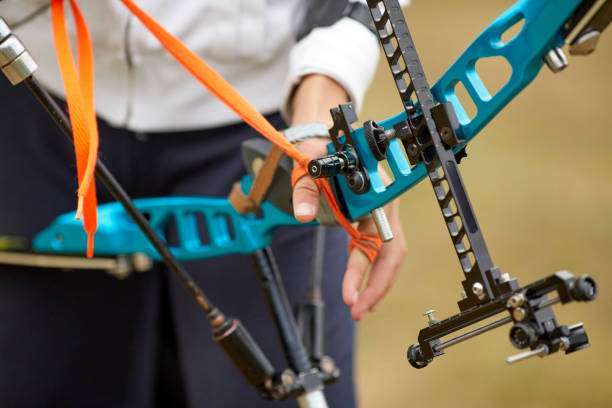
Many beginners treat arrows as “consumables” when buying them, believing that as long as the size is roughly right, they can be used. This misconception is one of the root causes of matching failures. In fact, in the compound bow system, the arrow is not a passive object that bears the force, but a core component that actively participates in the transmission of force.
An arrow experiences tremendous acceleration for an extremely short period upon leaving the bow, and it must maintain a controlled rhythm between bending and returning to its original position. If the arrow is too soft, it will deform excessively at the moment of release, resulting in a noticeable deviation at the tail. If the arrow is too stiff, it will not be able to fully absorb the energy released by the bow, causing continuous vibration.
This mismatch doesn’t immediately cause the arrow to miss its target, but rather makes each arrow slightly different. It is this non-repeatability that leads the archer to mistakenly believe that their movements are unstable, thus plunging them into endless self-doubt.
III. The Latent Influence of Draw Length Variation on Arrow Matching
Besides tension, draw length is another crucial variable that is often overlooked. Draw length determines the acceleration distance of the compound bow when the string is released, and changes in this acceleration distance directly affect the mechanical environment experienced by the arrow.
In archery, many beginners, when adjusting their compound bow, focus solely on whether it feels “comfortable to draw.” They simply pursue comfort during the draw, completely unaware that even a seemingly insignificant change of just one centimeter in draw distance can significantly alter the way energy is transferred during shooting.
Increased draw distance means the arrow is accelerated for a longer period. During this extended acceleration, the arrow must withstand greater force and pressure, inevitably increasing the demands on its rigidity. In other words, to accommodate the changes brought about by increased draw distance, the arrow needs higher rigidity to remain stable during acceleration and prevent deformation or damage.
Conversely, if the draw length is too short, the arrow may not be able to fully realize its designed performance during firing. Each arrow is designed with specific performance parameters and applicable conditions, and the draw length is one of the important factors. When the draw length is too short, the arrow cannot obtain sufficient acceleration and power, and therefore cannot fully realize its originally designed flight speed, accuracy, and range.
When the draw length is mismatched with the arrow’s parameters, archers often experience an unusual sensation during shooting that is difficult to describe precisely. For example, the sound of the arrow leaving the compound bow may become sharp and piercing, quite different from the smooth, deep sound of a normal arrow leaving the compound bow. Or, the archer may feel a slight vibration in their hand, a vibration noticeably different from the feel of a normal shot.
These unusual sounds and vibrations are actually signs of an imbalance in the entire archery system. Unfortunately, however, these important signals are often overlooked by archers. They fail to realize the problems hidden behind these subtle changes, which can potentially affect the shooting performance and experience.
IV. The Cruel Trade-off Between Arrow Weight and Speed
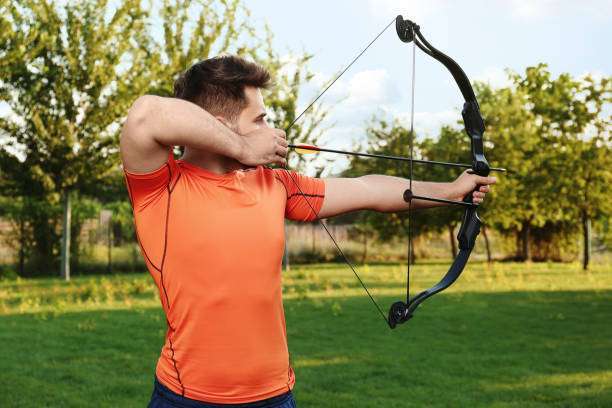
In compound bow shooting, speed is always a highly tempting metric. Many beginners are drawn in by the hype surrounding “high-speed arrows,” believing that the faster the arrow flies, the less it is affected by external interference, and therefore the higher the hit rate. However, speed is never free; it always comes at the cost of other forms of stability.
Lighter arrows do achieve higher initial velocities, but they also require greater stability during release. Any minute changes in attitude are amplified at high speeds. Conversely, heavier arrows, while having slightly lower velocities, exhibit greater inertial stability during flight.
The most common mistake beginners make is blindly pursuing speed before their fundamentals are solid. This not only fails to improve accuracy but also makes every mistake more noticeable, exacerbating feelings of frustration.
V. Shorter arrow length does not necessarily mean greater accuracy.
In some discussions, the idea that shorter arrows are more “efficient” often comes up. This view may be applicable in certain competitive situations, but it is extremely risky for beginners.
Arrow length affects not only weight distribution but also dynamic bending characteristics. While shorter arrows may appear more rigid, they offer extremely low tolerance for draw length and release consistency. Even the slightest change in the archer’s movement during release can cause unpredictable reactions in the arrow.
More importantly, safety issues are often overlooked. An arrow that is not long enough will approach the arrow rest or even exceed the safe range when fully drawn, which is extremely dangerous in actual combat. Stability should always take precedence over maximum performance.
VI. The rebalancing effect of arrow weight on the overall system
The arrowhead is not an independent component; it has a decisive influence on the overall weight distribution of the arrow. Changes in the weight of the arrowhead directly alter the arrow’s attitude stability during flight.
Heavier arrowheads provide greater stability to the arrow’s tip, improving its trajectory, but also reducing overall speed. Lighter arrowheads, on the other hand, demand a higher level of precision from the shooter. Some beginners find their accuracy plummets after changing arrowheads, often not due to a decline in skill, but rather a disruption of the system’s balance.
In the compound bow system, every seemingly minor adjustment can trigger a chain reaction. Ignoring this can lead to getting lost in repeated attempts.
VII. Adjusting tension does not equal improving ability.
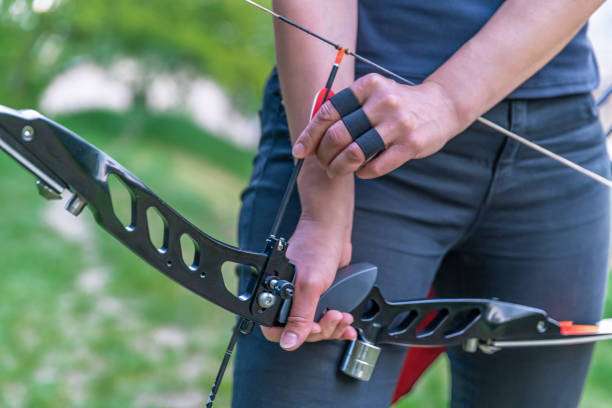
the compound bow is a huge advantage over the traditional compound bow , but this advantage is often misused. Many beginners, after feeling that it is “easy to draw,” immediately choose to increase the draw weight, hoping to achieve better shooting performance as soon as possible.
However, increased draw weight places higher demands on the arrow. If the arrow’s parameters aren’t adjusted accordingly, the system imbalance will worsen. The archer might feel “more powerful” in the short term, but their accuracy will continue to decline.
A truly reasonable adjustment of the tension should be based on the premise that the arrow has already been properly matched. Otherwise, each increase in tension will only amplify the existing problems.
8. Why beginners must develop a holistic matching mindset
Compound bow shooting is not a simple output of force, but a highly systematic and coordinated process. Pull force, draw distance, arrow rigidity, weight distribution, and release method are intertwined to form a dynamic equilibrium system.
The biggest pitfall for beginners is trying to solve the overall problem by optimizing a single point. Changing the arrow without adjusting the draw weight, or increasing the draw weight while ignoring the weight of the arrowhead—all these actions will make the system increasingly complex and difficult to control.
A truly effective learning path involves gradual adjustments based on a stable foundation, while understanding the logic behind each change. When you begin to view compound bows with systems thinking , improved accuracy will no longer be a fluke, but a predictable outcome.
Conclusion: Precision is not about putting in more effort, but about finding the right match.
compound bow shooting lies in the fact that it does not reward blind effort. Accuracy only arises naturally when power is transferred correctly, energy is absorbed properly, and the arrow and bow work in true synergy.
For beginners, avoiding the pitfalls of mismatched tension and arrow is more important than any skill training. Once the foundation is solid, technical progress will come naturally. Conversely, no matter how much time is invested, one will only be struggling repeatedly in the wrong system.