Compound Bow’s 7 Performance Optimization Strategies: Scientific Training and Powerful Modifications for Professional Drivers

In the competitive world of compound bow , archers who consistently achieve stable results at high levels never rely solely on talent or high-end equipment. Compound bow is a highly precise sport; equipment tuning, body control, mental resilience, and long-term training intensity all closely influence performance..
Many trainees initially fall into the trap of believing that simply using more expensive bow frames, newer sights, or lighter carbon fiber arrows will improve their scores. However, as training deepens, they gradually realize that performance optimization truly depends on multiple factors.
Professional athletes’ advantages often lie in the details; they not only understand how to train effectively but also how to maximize the performance of their equipment. This article will comprehensively analyze compound bow performance optimization strategies in seven key areas, from scientific training to in-depth modifications, presenting a complete and practical improvement plan.
Systematic training in body control is the core foundation of performance.
the compound bow relies heavily on its mechanical structure for assistance, the ultimate control of the compound bow still depends on the physical abilities of the bow-bowman. Professional archer training places great emphasis on comprehensive training of shoulder stability, latissimus dorsi activation, core strength, and sustained upper limb stability control.
The archery posture may appear static, but it is actually maintained by a large number of deep muscle groups. Beginners often experience hand tremors, aiming drift, and instability when drawing the compound bow , the core reason often being an incorrect distribution and application of body force.
Professional training improves consistency of movement through static stretching, isometric exercises, core stability training, and scapular control training. The better the body control, the stronger the stability of the compound bow at full draw, the smoother the aiming process, and the more concentrated the arrow’s impact point. Training physical ability does not require extremely high intensity, but rather emphasizes precise movements and consistent force application, thus laying a more solid foundation for subsequent equipment adjustments.

Detailed optimization of the archer’s movement process can determine overall stability.
A professional compound bow shooter’s movement sequence, from raising the bow, drawing it, locking it, aiming, to releasing the arrow, exhibits a high degree of consistency in every step. The stability of this movement sequence directly affects the consistency of the arrow’s flight; a good movement sequence allows strength, breathing, and focus to form a repeatable rhythm.
During training, many compound bow shooters habitually record videos of their movements, comparing them to identify any subtle differences in the height of the compound bow draw , the angle of the elbow, or even the tilt of the neck. Some compound bow shooters also use laser aiming aids to confirm the stability of the aiming path. Adjusting the movement sequence typically takes weeks or even months to stabilize, thus it is a long-term optimization process.
Professional athletes believe that the movement is not about being as effortless as possible, but rather as consistent as possible. Only after the compound bow shooter’s movement has matured does equipment adjustment become meaningful, because a stable movement allows the equipment parameters to be accurately reflected in the performance, rather than being masked by unstable body movements.
Adjusting and optimizing the bowstring system can lead to a significant improvement in shooting accuracy.
any compound bow involves adjusting the compound bow string system. The compound bow string not only transmits tension but also affects pulley synchronization, rebound speed, and arrow muzzle velocity. Professional archers regularly check their compound bow strings for moisture, deformation, or wear and use custom-made compound bow strings made of high-quality fibers to improve consistency.
Fine-tuning pulley synchronization is one of the most critical steps; if the pulleys are out of sync, even if other components are properly adjusted, the arrow will still deviate in flight. Furthermore, increasing the bowstring rebound speed effectively increases arrow muzzle velocity, resulting in a straighter trajectory and improved accuracy at medium and long ranges.
Optimizing the compound bow string isn’t just about changing materials; it involves repeatedly adjusting tension, winding layers, stabilizing the D-loop position, and observing the dynamic performance of the bowstring at the moment of release to ultimately achieve a balance between elasticity and stability. Professional archers almost always set bowstring parameters according to their own habits and training cycles to achieve the best match between equipment and the archer.
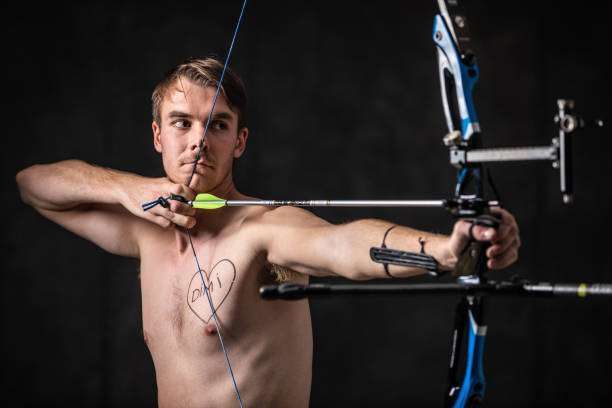
The combination of arrows and the arrow rest system affects the overall quality of flight performance.
The arrow system and the adjustment of the arrow rest together determine the initial direction and stability of the arrow after it leaves the bow. Experienced compound bow archers typically select the appropriate arrow weight and shaft stiffness based on the bow’s draw weight, draw length, and the competition event. Arrows that are too light are more susceptible to wind, while arrows that are too heavy will reduce initial velocity and affect the trajectory; therefore, precise matching is necessary.
Special attention needs to be paid to the center position and descent speed of the arrow rest. Different arrow rest structures result in different release times, affecting whether the arrow maintains its ideal straight trajectory. Professional archers use paper target testing, slow-motion filming, and arrow velocity testing to analyze the state at the moment of release, thereby gradually fine-tuning the arrow rest position. The shape and angle of the arrow’s tail fin also affect air resistance and flight stability. Therefore, during the optimization process, the combination of arrow and arrow rest needs to be tested multiple times to find the configuration that best suits their shooting style.
Stabilizers and counterweight systems are key hardware components for improving accuracy.
Many archers consider stabilizers merely shock absorbers, but professional archers view them as a core component for adjusting the overall dynamic balance of the compound bow . The length, weight, and angle of the stabilizer all affect how the bow vibrates during shooting.
Front weights allow the bow to maintain its natural forward tilt at the moment of release, making aiming more stable, while side weights help maintain balance in lateral forces. Professional archers typically test different combinations under various training conditions to determine which weighting system maintains minimal bow wobble under their own strength and movement patterns. The ultimate value of stabilizer fine-tuning is guiding the bow’s reaction force in a controllable direction, making the shooting process smoother and reducing aiming drift caused by vibration. The more sophisticated the equipment, the greater the importance of the stabilizer; therefore, professional archers rely increasingly heavily on stabilizer systems.
Fine-tuning the sights determines the final hit rate.
As the most direct tool for guiding the arrow’s landing point, the sight determines the upper limit of accuracy in actual combat. Professional archers adjust the aiming point height according to different distances and constantly test whether the horizontal and vertical alignment is consistent. Fine-tuning the sight involves more than just knob adjustments; it includes brightness adjustment, aiming point size selection, fiber optic brightness control, and optimization of the shock-absorbing structure.
If the aiming point is too bright, the archer may experience visual strain; if it is too dark, it is difficult to maintain clear positioning in changing lighting conditions. Furthermore, the tightness of the sight’s fixing parts also affects shooting consistency. Some professional archers even re-check all screws before each match to ensure the sight does not loosen after multiple shots. The ultimate goal of fine-tuning the sight is to achieve a stable field of view and easy aiming, allowing the archer to focus on power and rhythm without being distracted by visual errors.

Extensive modifications and personalized tuning allow the Compound Bow to reach its performance limits.
Professional archers typically don’t use the stock configuration directly. Instead, they perform extensive modifications based on their own shooting habits. These modifications include using custom grips, replacing modules with ones that better suit their power generation, changing the angle of the bow arm spacers, adding torque compensation accessories, and even adjusting the pulley rotation speed. All these modifications aim to provide the compound bow with the most stable feedback in specific shooting patterns.
For example, some archers who prefer a higher draw angle will replace their bow arm with one more suitable for high-angle releases; while others who prefer a smoother draw will choose a pulley design with more even energy distribution. The core value of these modifications lies in making the bow truly an extension of the archer’s body, ensuring a highly consistent power path, and making the archery action as natural as instinct.
Professional archers maintain a high level of performance precisely because they understand the deep connection between equipment and movement, and continuously strengthen this connection through modifications, allowing the compound bow to reach its maximum performance potential.
Conclusion
a compound bow is not something that can be accomplished with a single step. It is the result of a combination of physical training, movement techniques, the compound bowstring system, arrow matching, stabilizer weighting, and fine-tuning and extensive modifications to the sight. Professional archers demonstrate exceptional consistency in competition not only through training experience but also through a deep understanding of their equipment and long-term tuning. Every minor adjustment can lead to a qualitative improvement, and every practice session refines stability. Mastering these seven performance optimization strategies will allow any compound bow archer to improve accuracy, stability, and overall competitive performance in future training.