9 Truths About Compound Bow Revealed: The Huge Contrast Between Legendary Archers and Real-Life Archers

In numerous films and television series, the compound bow is often portrayed as a near-mythical weapon. The moment the protagonist draws the bow, aims, and releases the arrow is always accompanied by slow motion, close-up shots, and tense background music. The arrow soars through the air, accurately hitting the target dozens of meters away, as if shooting is an instinct rather than the result of long-term training. This highly romanticized presentation has instilled a strong yearning for the compound bow in countless viewers , but it has also unknowingly created a huge cognitive bias.
compound bow shooting in the real world and the “legendary marksmen” depicted in movies and television shows. Understanding this contrast not only helps in correctly understanding the sport of compound bow but also helps beginners develop more rational and safer learning expectations.
The Compound Bow in Film and Television : A Mythologized “All-Purpose Long-Range Weapon”
In movies and TV series, the compound bow almost never fails. Whether in forest chases, urban combat, or extreme weather conditions, the bow and arrow maintain consistent lethality and astonishing accuracy. Characters often draw and fire while moving at high speed, requiring almost no breathing adjustments, and exhibiting no hand tremors or psychological fluctuations.
This approach portrays the compound bow as a weapon that requires no effort. Viewers rarely see the characters undergoing systematic training, much less miss due to fatigue, tension, or technical errors. Shooting is simplified into an elegant and swift movement, rather than a technique heavily reliant on repetitive training and muscle memory.
This mythologizing not only exaggerates the practical combat capabilities of the Compound Bow , but also downplays its high dependence on body control, psychological stability, and equipment adjustment during firing.

II. Real-world Compound Bow archers: Skill far outweighs talent
Real compound bow shooting is an extremely detail-oriented sport. In the realm of compound bow shooting, every minute detail can have a significant impact on the final shooting result. Even with today’s modern compound bow systems, which boast more advanced designs and precise performance, shooters still need to maintain a high degree of consistency in several key aspects.
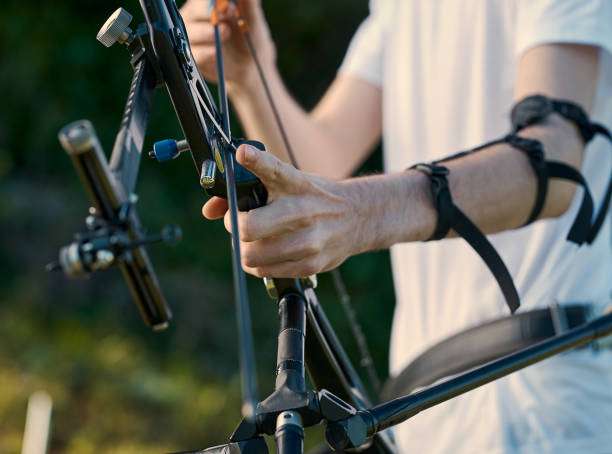
These elements include stance, ensuring balance and stability to lay a good foundation for subsequent movements; grip pressure, as appropriate pressure ensures effective control of the bow; draw path, a standardized and stable path ensures the arrow’s flight direction; anchor point position, a precise anchor point improves shooting accuracy; and release timing, a well-timed release is key to high-quality shooting.
In real life, outstanding archers don’t stand out because of innate superhuman strength. Instead, they have an almost obsessive pursuit of standardized movements. They deeply understand the importance of precision and standardization in shooting, so they tirelessly adjust their stance repeatedly to achieve the optimal shooting posture. Simultaneously, they carefully correct the symmetrical distribution of force on their shoulders, as uneven shoulder force can lead to body posture deviations, thus affecting shooting accuracy.
Furthermore, they meticulously check for excess muscle tension, as this stiffens movements and hinders peak performance. It’s important to understand that in compound bow shooting, any minute deviation will be magnified infinitely at tens of meters. Even a tiny mistake can cause the arrow to miss the target by a considerable distance.
In movies and TV shows, we often see spectacular moments of “one arrow achieving godlike status,” where the protagonist seems to effortlessly achieve a brilliant victory with a single shot. However, in reality, such moments usually mean that the archer has accumulated experience through thousands of failed shots. They need to constantly learn from their mistakes, adjust their movements and mindset, and undergo long periods of rigorous training and countless attempts before they can finally achieve that remarkable moment of success.
III. Rally Fantasy: The Severely Underestimated Physical Exertion in Film and Television
Characters in movies are often able to maintain a fully drawn bow for extended periods, even engaging in dialogue and observing their surroundings before calmly releasing the arrow. This performance almost completely defies the realities of human biomechanics.
Even with the compound bow’s clearly designed energy-saving phase, a full pull still continuously strains the core, back, and stabilizing muscles. Real-world shooters typically aim and release within seconds, avoiding prolonged periods of tension, otherwise arm tremors and postural breakdowns are almost inevitable.
The neglect of tension in movies and TV shows leads many beginners to mistakenly believe that “if you can pull it, you can shoot accurately,” resulting in them choosing excessively high tension, which ultimately leads to distorted movements, decreased accuracy, and even sports injuries.
IV. The truth about hit rates: Film editing masks failures.
In various films and television shows, we often see a phenomenon where shooting scenes almost always hit their targets. Whether it’s pistol shooting, rifle shooting, or other types of shooting, the bullets seem to have eyes, accurately hitting their targets.
This isn’t a true reflection of reality, but rather an inevitable result of editing logic. During film and television production, editors select appropriate shots to present based on the needs of the plot and the overall rhythm. Missed shots, those that miss their targets, are usually not shown to the audience. This is because these missed shots don’t fit the narrative rhythm of the film or television show, disrupting the story’s flow and tension, and significantly diminishing the viewer’s viewing experience.
However, real-world compound bow training is vastly different from the shooting scenes depicted in movies and television. It’s built upon a foundation of numerous failures. When someone begins compound bow training, they face a variety of problems and challenges that lead to shooting failures. For example, incorrect posture, uneven force application, and unstable breathing can all affect shooting accuracy, causing the arrow to miss the target.
Even highly skilled archers cannot maintain perfect form indefinitely. They too experience fluctuations in performance; sometimes they may be in peak condition with a high hit rate, but other times they may enter a phase of consecutive misses. During this phase, no matter how they adjust, it’s difficult to hit the target. Moreover, an archer’s hit rate doesn’t improve linearly. That is, it doesn’t steadily increase with training time. In fact, during long-term training, the hit rate will fluctuate repeatedly. For a period, the hit rate may improve, but then it may decline for various reasons. Only after many such repetitions will the hit rate slowly rise, exhibiting a tortuous upward curve.
Therefore, understanding that failure is an indispensable part of the shooting process is a crucial psychological shift from being immersed in cinematic fantasies to becoming a real shooter. Only when we truly recognize that failure is normal and inevitable in shooting training can we face setbacks and difficulties with a more peaceful and rational mindset, continuously adjust ourselves, and ultimately gradually improve our shooting skills.
V. The Misleading Effects of Sights and Intuitive Shooting
A common scene in movies and television shows is a character firing almost without looking at the sights, relying solely on instinct. This reinforces the myth of “natural shooting” while ignoring the heavy reliance of modern compound bows on aiming systems.
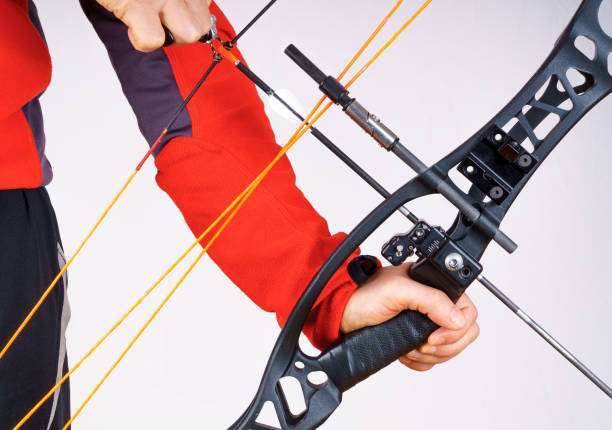
In real-world compound bow shooting, especially at medium to long ranges, a precisely calibrated sight is indispensable. Shooters need to make minute adjustments to the aiming point based on changes in distance, lighting conditions, and personal posture. So-called “intuitive shooting” is often built upon deep muscle memory developed over years of using the same equipment and operating at the same draw distance, rather than random improvisation.
The simplified expressions used in film and television obscure the true weight of technological accumulation.
VI. Environmental Adaptation: Real-world Variables Ignored by Film
In the movie, the Compound Bow seems to perform consistently well regardless of whether it’s in a rainforest, snowfield, or at night. However, in reality, environmental changes have a significant impact on shooting accuracy.
Humidity alters the bowstring’s position, temperature affects material elasticity, and wind direction and speed directly influence the arrow’s trajectory. Professional archers need to learn to read environmental information and make corresponding adjustments before firing. This ability cannot be acquired through a single “heroic shot.”
The neglect of environmental variables in film and television works makes shooting seem too simple and misleads the audience’s perception of the difficulty of actual combat.
VII. Psychological pressure: The calmness beautified by the camera
While the dramatic tension of film and television characters maintaining absolute composure in life-or-death situations is certainly present, it severely underestimates the impact of psychological pressure on shooting.
In real-world compound bow shooting, especially in competition or hunting environments, increased heart rate, sweaty hands, and distraction are common problems. Shooters must undergo systematic training to learn how to maintain breathing rhythm and stable movements under pressure.
A true master is not someone who is free from tension, but someone who can maintain consistency in their movements even under pressure.
8. Training Time: The Compressed Growth Cycle in the Movie
Film and television works often use montage to quickly showcase a character’s growth, giving viewers the illusion that they have “mastered compound bow in a short period of time .” However, in reality, developing stable shooting ability often requires months or even years of continuous training.
This process includes building basic skills, solidifying movement patterns, understanding and adjusting equipment, and psychological adaptation. Skipping any stage will lead to problems later on, manifesting as inconsistent accuracy.
Compound bow is not a skill that can be learned quickly; rather, it is a sport that demands an extreme level of patience.
IX. From Legend to Reality: Understanding the True Allure of Compound Bow
Stripped of its cinematic filter, the Compound Bow doesn’t lose its charm; instead, it reveals a more authentic and respectable side. It’s no longer the exclusive tool of gifted heroes, but a skill that anyone can gradually master through effort.
True satisfaction doesn’t come from the instant of a successful shot, but from the long-term process of gradually stabilizing the movement and improving accuracy. Understanding this is a crucial step in transforming from a “spectator” into a “shooter.”
Compound Bow is far from as easy as the movie, but it is precisely because of this real difficulty that every step forward is all the more precious.