Compound Bow’s 10 Outdoor Safety Guidelines: Key Points for Achieving Both Accuracy and Stability

Of all shooting environments, outdoor scenarios are the true battlefield that tests a compound bow shooter’s comprehensive abilities. The variables here are far more complex than indoors: temperature, humidity, wind direction, lighting, terrain, vegetation density, noise reflection, foot stability, and spatial limitations of the moving environment—each directly alters the bow’s performance and the shooter’s judgment. When you take a compound bow into the wild, it’s no longer just about accuracy but about maintaining consistent output while ensuring safety.
Therefore, establishing a comprehensive safety guideline for outdoor scenarios not only reduces errors but also allows shooters to maintain confidence and control in complex environments. The following ten key principles, covering equipment, operation, environmental awareness, and mental state, will help you balance safety and accuracy in any outdoor compound bow shooting situation.
the outdoor environment on compound bow shooting behavior
For many beginners, the difficulty of outdoor shooting often stems not from technical issues but from a lack of accurate judgment of environmental variables. The structure and mechanics of a compound bow make it sensitive to environmental conditions. For example, the bowstring will stretch or contract slightly due to changes in humidity; a compound bow with a short wheelbase will deviate more noticeably in crosswinds; and wet fletching increases drag, causing a slight descent in flight.
These changes often don’t exist indoors, making outdoor shooting a true test of a compound bow shooter’s cognitive abilities. The first thing to understand is that the outdoor environment doesn’t give way to anyone, and compound bow shooters must proactively adjust their techniques to adapt to constantly changing conditions. Only by recognizing this complexity can a clear objective be established in subsequent safety strategies.

Conduct a comprehensive check of the equipment’s condition before the official firing.
Compound bows experience greater stress outdoors than indoors, making pre-shoot equipment checks crucial. The bowstring must be inspected for wear, cracks, and loosening, especially in humid conditions where the bowstring fibers are more prone to fatigue after absorbing moisture. Furthermore, minor issues such as small cracks in the bow arm, smooth bow wheel rotation, loose bow handle screws, deformed arrow shrapnel, and sight misalignment due to movement are all magnified outdoors and can even lead to dangerous malfunctions like string slippage. Rigorous equipment checks are the first line of defense for outdoor safety and a prerequisite for maintaining consistent accuracy.
Ensure the absolute safety and controllability of the firing area
Outdoor environments are complex, especially in areas with undulating terrain, dense forests, and numerous obstructions. If the firing direction is not clearly confirmed, friendly fire can easily occur. Therefore, a pre-firing area reconnaissance is essential to ensure that there are no people, vehicles, or hard objects that could reflect the arrow within at least 200 meters of the firing direction.
When using a compound bow in a natural environment , the shooter must have a minimum level of “environmental ownership,” meaning ensuring the target’s direction is completely controllable. If wild animals, hikers, or other uncontrollable factors are present, the compound bow aiming action should be stopped immediately. Confirming the firing environment is always more important than accurate hits.
The critical impact of field ground stability on shooting posture
Compound bow shooting demands extremely high stability, but outdoor terrain is often uneven; soft soil, gravel, dead branches, and tree roots can all cause instability, making it difficult to control the timing of the shot.
Therefore, shooters should spend a few seconds assessing their footing before firing, ensuring that their center of gravity can remain stable and still for at least three seconds. Psychologically, a stable stance reduces anxiety about body control and increases confidence when drawing the compound bow ; physically, the more stable the stance, the less the compound bow deviates at the moment of release, and the more linear the arrow velocity remains—the foundation of all accuracy. In outdoor shooting, a stable stance is more fundamental and important than any aiming technique.

The significant impact of wind direction and speed on arrow speed
Wind is the most critical and unpredictable variable in outdoor shooting; the difference in arrow deviation under different wind speeds can exceed expectations by several times. Although compound bows enhance output stability through their wheel structure, their light weight and large contact area make them extremely prone to deviation under wind. In crosswind conditions, taking a medium distance of 30 to 40 meters as an example, for every increase in wind speed, the arrow deviation can reach several centimeters.
Shooters must learn to use natural elements in the environment to judge wind direction, such as observing changes in wind pressure on grass, treetops, and the skin, and adjust their aim accordingly. When the wind speed is too high, shooting should be stopped decisively. Knowing “when not to shoot” is a sign of a mature outdoor shooter.
Potential interference of light changes with aiming point judgment
Outdoor lighting is far more complex than indoor lighting. The angle of light, the position of shadows, and the intensity of reflections all affect the visibility of the site. Shooting against the light will make the pinpoint appear dim, easily leading to misjudgment, while sidelight can cause localized reflections inside the sight, interfering with aiming. Sudden changes in light caused by moving clouds can also cause the shooter to suddenly lose visual reference after fully drawing the compound bow.
Countermeasures include determining the sight brightness in advance, wearing goggles to reduce glare, and quickly scanning the lighting environment before drawing the compound bow. When the light changes drastically, the shooter should avoid firing prematurely, as inaccurate visual judgment will directly affect the arrow’s point of impact.
Temperature and Humidity Changes on Compound Bow Structures
Outdoor temperature and humidity variations affect the string tension, bow shank resilience, and sight accuracy of a compound bow . For example, in low temperatures, the bowstring tightens, increasing the overall draw weight and making the draw feel heavier; conversely, in high humidity, the bowstring absorbs water and expands, slightly reducing tension and thus lowering energy output.
More importantly, these changes are often imperceptible but accumulate over repeated shots, causing a continuous shift in accuracy. Experienced archers conduct several test shots after each new environment entry to recalibrate their feel and aim, thus avoiding uncontrollable errors in actual shooting. Understanding the microscopic effects of the environment on the bow is crucial for stable output in outdoor combat.
The risk of accelerated physical fatigue during outdoor shooting.
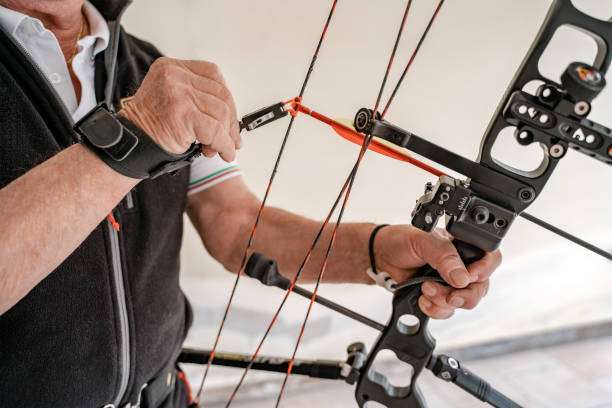
Walking, climbing, carrying heavy loads, and prolonged exposure to the elements all accelerate physical fatigue. Compound bow shooting demands extremely high core strength and shoulder and back muscle groups; shooting while fatigued can easily lead to problems such as deformed bow drawing posture, prolonged pre-draw time, and finger tremors at the moment of release.
During outdoor shooting, it is crucial to pay attention to the level of fatigue. If shoulder stiffness, forearm soreness or numbness, or irregular breathing occurs, action should be stopped immediately. Fatigue not only affects accuracy but also significantly increases the risk of operational errors, such as unintentional string release, unstable bow drawing, and changes in finger grip angle. Maintaining physical condition is a vital component of safety in outdoor shooting.
Precautions for dealing with emergencies in the wild
Outdoor environments are often unpredictable, with potential for sudden animal appearances, sudden changes in wind pressure, or slippery ground. Archers must cultivate the habit of being prepared to stop at any moment while drawing the bow and aiming. The compound bow structure has “rest point pressure,” meaning the longer an archer remains with the bow fully drawn, the greater the danger. Therefore, if the surrounding environment changes, the bowstring should be released immediately without hesitation. Furthermore, walking with one hand while shooting outdoors is strictly prohibited, as falls on unstable terrain can damage the bow arm or even dislodge the bowstring. Maintaining alertness to unexpected situations is a fundamental safety awareness that all outdoor weapon users must possess.
Secure communication mechanisms in team or multi-person environments
Communication is crucial when shooting in multi-person environments or training ranges. The “shooting zone,” “waiting zone,” and “arrow retrieval zone” must be clearly defined, and every member must be acknowledged before leaving a safe area. During field training, team members must maintain visual or verbal communication. Any member entering the firing line must receive a clear response from the shooter. Furthermore, in multi-target training, the firing order must be consistent to prevent anyone from entering the forward area before others have finished firing.
Psychological stability and focus management in outdoor shooting
The complex outdoor environment easily puts an archer’s brain in a highly active state, making mental stability the ultimate factor affecting accuracy. Wind, rustling leaves, distant noise, and reflected light can all cause a shift in focus. Archers should establish a stable compound bow routine, such as taking a deep breath, confirming their center of gravity, adjusting their grip angle, and stabilizing their shoulder line, allowing their body to enter a highly consistent rhythm. The more stable the routine, the better it filters out external distractions. Mental stability is not only a guarantee of accuracy but also a necessary condition for preventing dangerous actions under pressure.