Compound Bow: 6 Tips for Quickly Adapting to Different Venues: Effective Solutions for Improving Performance in a Short Time

compound bow shooting lies not only in maintaining consistency in the movements themselves, but also in adapting to different shooting environments in a short period of time. From indoor compound bow arenas to outdoor open ranges, from wind-swept highlands to humid forest tracks, and even variations in ground texture and light direction, all subtly influence the shooter’s mental state, body rhythm, and arrow trajectory. Many shooters achieve consistent results in training, but their performance fluctuates significantly when the environment changes.
This isn’t due to a decline in skill, but rather to the body, vision, perception, and psychology failing to adapt to the new environment. Professional shooters, on the other hand, often rely on their ability to quickly analyze the environment and establish a shooting rhythm specific to the current location, making the environment an asset rather than a liability.
This article will delve into six core methods to analyze how compound bow shooters can quickly master the characteristics of different environments, adjust their state in a short time, and achieve a more consistent performance.
By reducing light interference through visual adaptation, the aiming system can quickly stabilize in new environments.
Light is one of the key factors affecting aiming and the arrow’s impact point in compound bow shooting. Whether it’s soft indoor lighting, direct sunlight outdoors, diffused light on a cloudy day, or the interplay of light and shadow created by trees, all these factors influence visual perception and aiming point identification.
Upon arriving at an unfamiliar location, the first thing a compound bow shooter needs to do is quickly adapt their visual system. Visual adaptation is not just about getting the eyes to “see clearly,” but also about the brain re-establishing the connection between light intensity and color contrast, thus forming a new sense of visual stability.
Skipping this step will often result in compound bow shooters experiencing a drifting center point, a darker vertical line, a more pronounced red dot reflection, or inconsistent left-right positioning when aiming.
To allow the visual system to adapt quickly, compound bow shooters need to undergo continuous fixation training shortly after arriving at the shooting range. This involves focusing on points of varying light levels at different distances and in different areas, enabling the eyes to dynamically adjust in a short time.
Furthermore, adjustments to the compound bow ‘s brightness, reticle size, and visor angle all require fine-tuning based on the environment. For example, in bright light, the reticle tends to shine, necessitating brightness adjustments or the use of a visor to reduce reflections. In low light, brightness needs to be increased or the reticle area widened to maintain a stable visual focus. Once the visual system stabilizes, the shooter’s aiming movements can quickly return to a familiar rhythm.
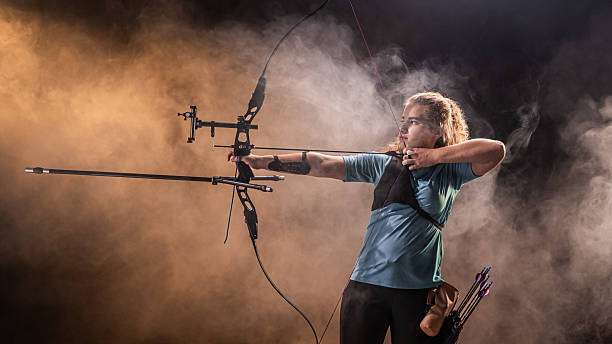
By analyzing wind direction, flight predictions can be established to prevent the rocket’s speed from being dictated by the environment.
In outdoor shooting ranges, wind direction is often the most significant variable affecting the arrow’s trajectory. Wind not only alters the arrow’s flight path but also changes the archer’s stability and rhythm.
Adapting to a new range quickly requires compound bow archers to rapidly analyze the wind direction and incorporate it into their shooting predictions. Wind direction analysis is typically conducted from three perspectives: physical perception, visual observation, and arrow feedback. Physical perception is the most direct method, such as feeling the wind on the back of the hand, face, or clothing, and judging whether the wind is stable by observing instantaneous changes in wind force.
Visual observation includes observing the direction of the swaying grass at the shooting range, the angle of the flags, and fine dust particles in the air. Most importantly, feedback from test shots is used to determine the true extent of the wind’s influence by observing the deviation in the arrow’s landing point.
Once the wind direction and speed patterns are identified, compound bow shooters can re-establish their aiming compensation strategy without letting the wind become a factor affecting their psychological stability. Professional shooters typically make crucial judgments during wind fluctuations, such as choosing to shoot when the wind weakens or automatically adjusting the lateral shift of the aiming point to keep the flight trajectory safe and stable in the wind. Only by mastering the logic of wind direction can shooting actions regain a sense of control in a short time, allowing shooters to quickly adapt to unfamiliar outdoor terrain.
Adjust your stance according to the ground material to maintain stability and ensure consistent output in unfamiliar environments.
Ground texture has a significant impact on stance stability. Many archers mistakenly believe that stance is solely controlled by their own strength, but in reality, different ground textures affect the body’s reaction force against the ground, requiring the balance system to readjust over time.
For example, standing on grass causes the body to sink slightly, resulting in a shift in the center of gravity; on wooden floors, one needs to adapt to the rebound; and on hard concrete, the subtle support for the feet is more pronounced than on training grounds. If the body does not complete the balance system reset quickly enough, it can lead to shoulder tension when pulling the compound bow , a shift in the center of gravity during release, or instability during the aiming phase.
A key method for quickly adapting to different terrains is to perform a brief, low-intensity adjustment of the bow stance upon arrival, allowing the body to re-establish ground feedback from the feet. Compound bow shooters need to feel the pressure distribution between their feet and the ground, especially the balance between the forefoot and heel, allowing the body to quickly rediscover the familiar stance and center of gravity from training.
Furthermore, for slippery or uneven surfaces, compound bow shooters need to actively adjust their stance distance or foot angle to find a stable balance point for output on the current terrain. Once the stance is stable, the entire movement chain can regain familiar control, thereby rapidly improving compound bow shooting performance.
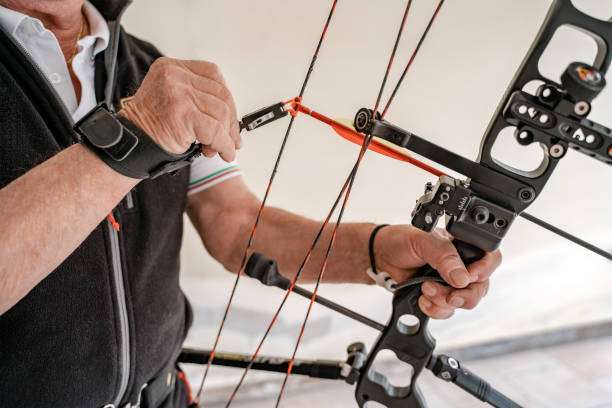
Use your breathing rhythm to quickly enter the compound bow match state and switch your body into match mode.
Environmental changes often cause a shift in the body’s rhythm, thus affecting the execution of movements. Many shooters experience shortness of breath, rapid heartbeat, and stiff neck and shoulders when entering an unfamiliar arena, resulting in significantly lower scores in the first round of practice shots. In order to quickly restore the body to the stable state it has been training in, shooters must use techniques to reset their breathing rhythm, allowing their nervous system to switch to the familiar compound bow shooting mode.
The key to a good breathing rhythm lies in using deep breathing to reduce autonomic nervous system excitation. Compound bow shooters can take several deep, long inhalations before a practice shot, followed by slow exhalation. This relaxes the shoulder and back muscles, making the first phase of the compound bow movement more natural.
Once in the competition, rhythmic breathing is needed to maintain stability during the aiming phase, such as inhaling to prepare, pausing briefly, exhaling to aim, and releasing slowly. This pattern not only makes the movement controllable but also enhances the compound bow shooter’s mental focus, preventing the unfamiliar environment from becoming a distraction. Breathing is the easiest rhythmic tool for shooters to control in a new arena; when used properly, it allows the body to quickly enter a stable state.
Adjust the equipment details to best match the Compound Bow with the venue environment.
The performance of a compound bow varies depending on the terrain, influenced by factors such as temperature, humidity, air density, and even light reflection. Therefore, archers must fine-tune their equipment to ensure optimal compatibility between the bow and the environment during rapid adaptation.
For example, in high humidity, the bowstring may loosen, requiring adjustment of the string tension; in low temperatures, changes in material hardness can cause slight variations in the arrow’s initial velocity, necessitating adjustments to the aiming point; and in areas with complex lighting, the scope’s brightness and shading angle need timely adjustments to maintain a stable visual focus. Furthermore, the stabilizer’s weights may need to be replaced in windy or uneven terrain to keep the reaction force within a manageable range.
Equipment adjustments aren’t about drastically altering the performance of the compound bow , but rather about making it more suitable for the terrain. Making quick, minor tweaks allows the shooter to rapidly regain consistency in their movements, ensuring the equipment performs the same in unfamiliar environments as it does in training, thus achieving stable results.

Mental rehearsal creates a sense of familiarity, quickly making an unfamiliar setting feel “controllable”.
Mental rehearsal is one of the most effective techniques for adapting to different environments. Upon arriving in a new environment, archers need to familiarize themselves with it mentally through observation, simulation, and mental rehearsal. Rehearsals can begin with walking along the target path to familiarize the body with the route; visual simulations can be done by considering the angle of stance, lighting direction, and sense of distance; and internal simulations can be performed by considering the rhythm of drawing the bow, aiming, and releasing it.
Through these mental rehearsals, the environment will no longer feel unfamiliar, the archer’s pressure will decrease, and they will more easily enter a stable state.
Mental rehearsals also help identify potential risks on the field in advance, such as sudden changes in wind direction, areas of light reflection, or uneven ground. When these situations are mentally marked in advance, players won’t be caught off guard during the actual match but can respond calmly. Rehearsals not only build familiarity but also strengthen a sense of control, allowing shooters to achieve mental stability in a short period of time, making the new field feel no different from the training ground.
Conclusion
compound bow shooting, quickly adapting to different terrains is not only a skill, but also a crucial ability for victory. Six key factors—light, wind direction, ground conditions, rhythm, equipment, and mindset—jointly determine whether a shooter can reach a stable state in a short time. Mastering these methods allows shooters to overcome their fear of unfamiliar terrains, viewing them as readable, controllable, and usable resources, making each match a stage for optimal performance. When adaptation speed becomes an advantage, shooters can enjoy true control and consistent performance in high-pressure, highly variable shooting environments .